


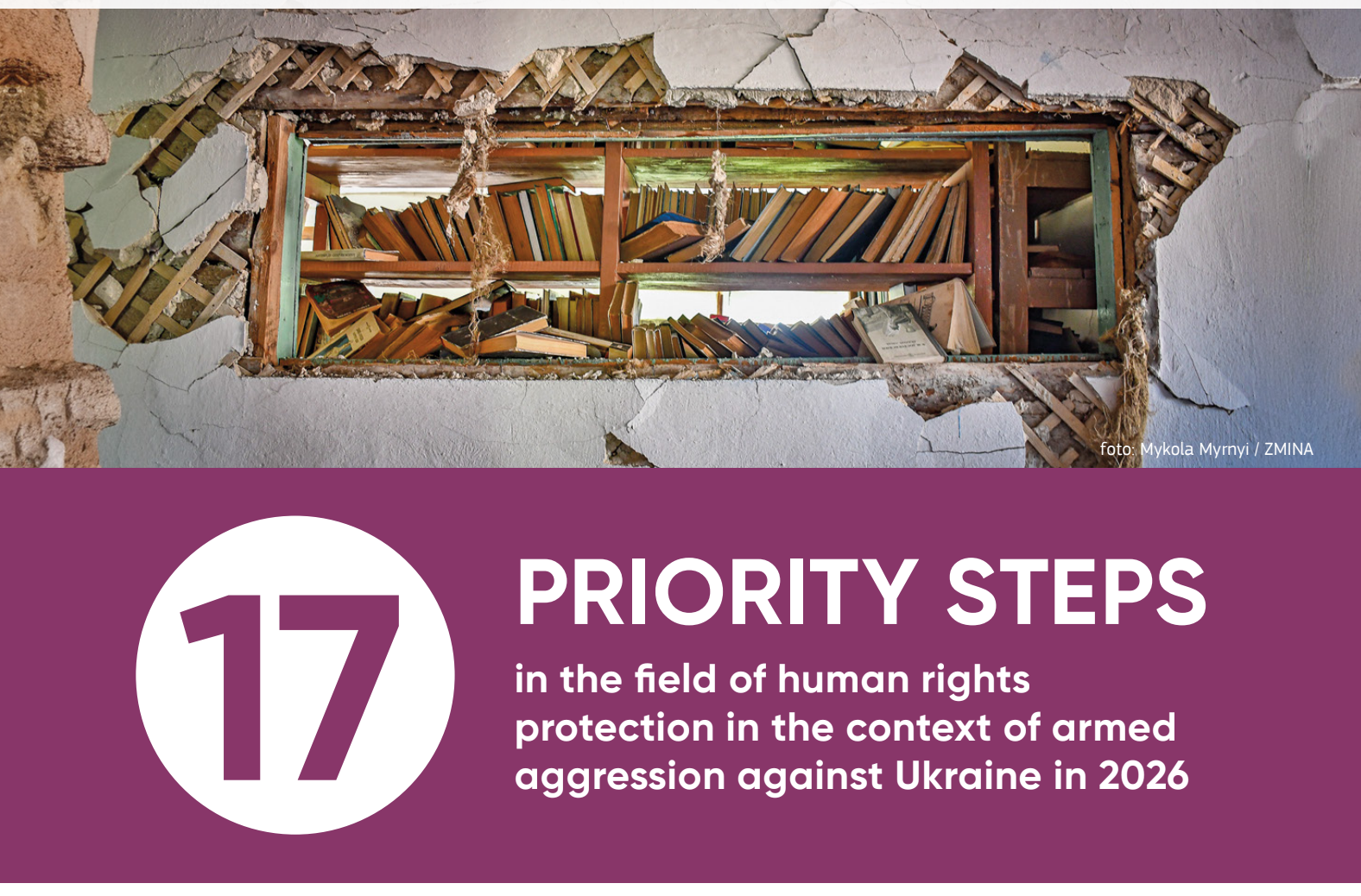
February 2026 marks 12 years since the Russian Federation launched its armed aggression against Ukraine. Nearly 20% of Ukraine’s territory remains under occupation, and every day the occupying state continues its military offensive, destroying Ukrainian cities and killing Ukrainian civilians and military personnel. Despite all the “peace initiatives” of 2025, the Russian Federation shows no intention of ending the war against Ukraine and its citizens. Moreover, the Russian Federation is doing everything it can to continue this war and destroy the ties between the residents of the temporarily occupied territories (hereinafter – TOT) and Ukraine. According to the UN Human Rights Monitoring Mission in Ukraine, 2025 was the deadliest year for the civilian population in Ukraine since 2022, with the level of casualties 70% higher than in 2023. In view of this, the development of policies aimed at protecting the rights of war victims and maintaining ties with residents of the TOT of Ukraine remains an urgent need for the state.
Overcoming the consequences of hostilities, shelling of Ukrainian settlements, and especially residential and energy infrastructure, which continue in 2026, requires further joint action by the state, civil society, and international partners. Efforts must also be made to ensure justice for war victims – the harmonisation of national criminal legislation with international law, as well as the recording and compensation of all damage caused by the occupying state, remain pressing issues.
We, representatives of a coalition of organisations dealing with the protection of the rights of victims of armed aggression against Ukraine, present a consolidated position on the state’s priority steps in the field of human rights protection in 2026. The implementation of the recommendations below will ensure a consistent and predictable state policy towards war victims.
To the President of Ukraine:
1. Promote the issue of protecting the rights of victims of armed aggression by the Russian Federation, in particular residents of the TOT of Ukraine, in the negotiation process. The prolonged occupation of a significant part of Ukraine’s territory is leading to a deterioration in the situation of Ukrainian citizens who remain there. Currently, negotiations, information about which is available in the media, include mention of three vulnerable categories of citizens: prisoners of war, illegally imprisoned civilians, and children deported or forcibly displaced by the Russian Federation. At the same time, Russia systematically violates human rights on a daily basis in the occupied territories of Ukraine. The Russian Federation imposes its citizenship, denies access to essential services, implements a policy of mass nationalisation of property, kidnaps, imprisons and tortures civilians who remain under occupation. The practices of indoctrination and militarisation of Ukrainian children in the TOT are systematic. The occupying state is conducting forced mobilisation of Ukrainian citizens into the ranks of the Russian Armed Forces, which creates conditions for Russia to continue the war. It is obvious that only the complete de-occupation of Ukraine’s territory will enable the restoration and protection of the rights of Ukrainian citizens. At the same time, as long as the occupation continues, the occupying state is obliged to ensure compliance with the norms of international humanitarian law (hereinafter – IHL). Therefore, it is necessary that part of the negotiations with Russia on ending the war (a truce, a “freeze”, a ceasefire or other process, regardless of its name) should include ensuring basic conditions for residents of the temporarily occupied territories of Ukraine. Part of the peace agreements should be guarantees of unhindered departure from the TOT of Ukraine and protection of the rights of Ukrainian citizens residing in the TOT of Ukraine, in accordance with international law, access for national and international humanitarian organisations and monitoring missions to document human rights violations, ensure the search for missing persons, and provide safe and effective humanitarian assistance.
2. Prioritise the development of state policy regarding victims of armed aggression against Ukraine. As of early 2026, the state does not have a comprehensive strategy or vision for ensuring the rights of victims of the Russian Federation’s armed aggression, in particular those who have suffered damage to their lives and health. This situation is a consequence of the absence of an authorised body within the Cabinet of Ministers of Ukraine responsible for the formation and implementation of state policy in the field of protection and support for persons affected by the armed aggression against Ukraine. Until the beginning of 2025, this body was the Ministry for Reintegration of Temporarily Occupied Territories of Ukraine (hereinafter – the Ministry for Reintegration). After its liquidation, its powers and responsibilities were scattered among ministries, and some powers were lost (e.g., the formation of transitional justice policy). Each of the central executive bodies currently exercises separate, fragmented powers in relation to the affected population within its own mandate, effectively in a vacuum, without proper coordination, common goals or a unified vision. Most of the powers after the liquidation of the Ministry for Reintegration were transferred to the Ministry for Development of Communities and Territories (hereinafter – the Ministry for Development). However, in the ministry responsible for infrastructure restoration and regional policy, the affected population is not and cannot be a priority due to the significant number of other urgent tasks. It is therefore important to rethink the institutional “architecture” for the formation and implementation of state policy towards victims of the war.
3. Ensure coordination of the safe departure of children and young people from the temporarily occupied territories of Ukraine and introduce a model for their comprehensive support and reintegration. Despite the prolonged occupation, support for children and young people from the temporarily occupied territories of Ukraine remains fragmented at all stages: from preparing and carrying out their departure from the occupation to their adaptation and integration in the territory controlled by the Ukrainian government. At the same time, the departure from the TOT of Ukraine is accompanied by increased security risks (filtering procedures, psychological pressure and the risk of detention), significant financial costs in the absence of reliable information about routes and further support tools. In cooperation with international partners and foreign governments, it is important to prioritise the issue of comprehensive, continuous individual support for children and young people from the TOT of Ukraine during their departure, and to provide information, financial and logistical support, etc. At the same time, at the national level, it is necessary to initiate the development and implementation of a unified comprehensive model for the support and reintegration of children and young people after leaving the TOT of Ukraine. Such a model should provide, in particular, for a clear and rapid procedure for restoring or issuing documents certifying identity and confirming Ukrainian citizenship; mentoring programmes; and assistance with integration into the legal, social, educational, cultural, economic and information spaces of Ukraine. Given the acute demographic crisis and long-term needs for Ukraine’s recovery, the preservation and return of human capital, including the departure of children and young people from the TOT of Ukraine to the territory controlled by the Government of Ukraine, should be considered as one of the components of national resilience and the future of Ukraine.
4. Develop a balanced security strategy for the TOT of Ukraine and Ukrainian citizens residing there, taking into account the objectives of reintegration and social cohesion. At the national level, there is no security policy in place regarding the TOT of Ukraine and Ukrainian citizens who remain in these territories for a long time. In the absence of such a policy, the actions of the state and its actors, particularly in the field of national security, are sporadic, unpredictable and dangerous for Ukrainian citizens. Such policies often contradict public statements about the importance of maintaining ties with Ukrainian citizens in the occupied territories. These discrepancies lead to prejudice against residents of the TOT of Ukraine or Ukrainian citizens who originate from the TOT. This creates an image of a threat allegedly posed by Ukrainian citizens who reside in or have left the occupied territories. As a result, initiatives are being introduced at the state level that cause or reinforce negative perceptions of residents of the TOT of Ukraine and create risks of violating the rights of citizens living under occupation. For example, the law on multiple citizenship poses risks to the preservation of Ukrainian citizenship for residents of the TOT of Ukraine; the government’s initiative to require polygraph testing for those who are likely to have Russian citizenship obtained during the occupation imposes disproportionate restrictions on access to public service and creates risks of violating the right not to testify against oneself and the right to legal assistance. It is common practice to refuse to issue certificates for return to Ukraine or Ukrainian passports to residents of the TOT of Ukraine after their return as a measure to ensure national security. It is important to conduct a comprehensive analysis of the risks associated with people living in the TOT of Ukraine and to develop a holistic state vision, taking into account the conditions created by the occupying authorities in the TOT of Ukraine, awareness of the consequences of prolonged occupation, and recognition of the experience of Ukrainian citizens who have been living under occupation for a long time. An important component of this policy should be a strategic framework for preserving and strengthening social cohesion in Ukraine as an element of national security and a key condition for reintegration.
To the Verkhovna Rada of Ukraine:
5. Establish mechanisms for the use of information contained in documents issued under occupation. The state’s approach to documents issued in the TOT of Ukraine is based on the principle of their complete non-recognition in accordance with Article 9 of the Law of Ukraine “On Ensuring Rights and Freedoms and the Legal Regime in the Temporarily Occupied Territories of Ukraine”. An exception applies to documents confirming the fact of birth, death, and registration (dissolution) of marriage of a person in the TOT of Ukraine. However, even for these documents, recognition is possible only through court proceedings, which are lengthy, complex, and costly. During almost 12 years of occupation, millions of documents of various kinds have been issued in the TOT of Ukraine. In addition to civil status records, these include medical documents, education documents, property rights documents, court decisions, and documents confirming insurance (work experience) and wages, etc. Complete disregard of these documents and failure to take into account the information they contain creates barriers or makes it impossible for Ukrainian citizens to exercise their rights, and also significantly complicates reintegration after leaving the TOT of Ukraine. The state is effectively shifting all the negative consequences of the occupation onto the citizens themselves, which contradicts both IHL and the strategic goal of maintaining ties with the residents of the TOT of Ukraine. Therefore, the state must move from a policy of complete non-recognition of documents to a legally defined approach that provides for clear and transparent mechanisms for using information from certain categories of documents issued during the occupation, taking into account security factors. This approach should minimise harm to the rights and freedoms of Ukrainian citizens, reduce the burden on the judicial system, simplify preparations for de-occupation, and promote the effective reintegration of the TOT of Ukraine. The recognition of information from documents issued in the TOT of Ukraine should also be seen as part of memorialising and documenting the experience of occupation, both to preserve the evidence base, establish historical truth, and compensate for the damage caused.
6. Ensure the proper functioning of the national compensation mechanism for residential properties destroyed or damaged as a result of armed aggression against Ukraine. In the context of large-scale attacks by the Russian Federation on residential infrastructure, the national compensation mechanism is of particular importance as a tool for supporting victims whose homes have been destroyed or damaged as a result of the Russian Federation’s armed aggression. The availability of such support is a necessary element of recovery, prevention of further waves of displacement, and creation of preconditions for the return of Ukrainian citizens from abroad. At the same time, the compensation mechanism introduced by Law of Ukraine No. 2923-IX, despite its prompt launch in 2023 and practical results, does not provide for compensation for owners of housing that, as of 24 February 2022, was located in the TOT of Ukraine and was destroyed or damaged before the start of the full-scale invasion by the Russian Federation. To address these gaps, it is necessary to adopt Draft Law No. 13136, which expands the temporal and territorial scope of access to the national compensation mechanism and broadens the circle of eligible beneficiaries. In 2025, a governmental initiative introducing housing vouchers for internally displaced persons (hereinafter – IDPs) from the TOT of Ukraine who are combatants and persons with war-related disabilities was launched as a further component of the national compensation mechanism. However, if financial resources are available, it would be advisable to extend it to other categories of IDPs whose homes remain in the temporarily occupied territories of Ukraine and are located in settlements that have become uninhabitable. An additional systemic barrier to the compensation mechanism is the lack of information about property rights in the State Register of Property Rights to Immovable Property (hereinafter – the State Register). This makes it impossible for a significant number of victims to receive compensation. According to the Ministry for Development, approximately 9.6 million persons are unverified housing owners. Entering information into the State Register on ownership of housing acquired before 1 January 2013 is complicated by the lack of access to the archives of the Bureau of Technical Inventory (hereinafter – BTI) and is reduced to lengthy and financially burdensome court proceedings. To resolve this issue, it is necessary to adopt draft law No.11440 in the second reading and simplify the judicial procedure for confirming ownership rights. At the same time, applicants in this category of cases should be exempted from paying court fees, and these cases should be removed from civil proceedings and transferred to separate proceedings.
7. Amend the Criminal Code of Ukraine to ensure compliance with the principles of legal certainty and proportionality in matters of liability for collaborative activities. Since March 2022, new articles have been added to Ukrainian criminal law: “collaborative activity” (Article 111-1) and “aiding an aggressor state” (Article 111-2). An analysis of the practice of prosecuting collaborative activity (a total of 3,103 convictions as of 1 January 2026) confirms that broad wording in the legislation leads to a lack of understanding of the limits of permissible and criminal behaviour, broad interpretation of these norms and, as a result, the criminalisation of almost any actions of Ukrainian citizens in the TOT. Contrary to IHL standards on the protection of persons performing life-support functions in the TOT of Ukraine, the practice of prosecuting firefighters, housing and communal services workers and chief doctors continued throughout 2025. As of January 2026, there are at least 14 draft laws in parliament that provide for amendments to Article 111-1 of the Criminal Code of Ukraine, amendments to Article 111-2 of the Criminal Code of Ukraine, or relate to the issue of restricting the rights of those accused of collaborative activity. However, none of them have been implemented. Despite the importance of the changes mentioned in numerous reports by both international organisations and Ukrainian NGOs, there has been no substantive discussion of this issue in parliament. In addition to clarifying the wording of Article 111-1 of the Criminal Code of Ukraine, it is worth considering the possibility of removing the least serious category of violations from the sphere of criminal justice and ensuring lustration measures, as well as considering the possibility of developing legislation on amnesty.
8. Take into account the interests of residents of the TOT of Ukraine, residents of frontline communities, and IDPs in the first post-war elections. Citizens residing in the TOT of Ukraine will face significant barriers to participating in elections as a result of the consistent policy of the Russian Federation. In this context, it is necessary to ensure that the rules for conducting elections are determined in advance and that Ukrainian citizens who, as a result of armed aggression against Ukraine, have limited access to their electoral rights are properly informed. It is also advisable to consider the possibility of voting on the basis of a certificate of return to Ukraine in the absence of a Ukrainian passport, taking into account the need to extend the validity of the certificate (currently, this period cannot exceed 30 days). It is very likely that it will be impossible to organise elections in the areas affected by hostilities and in neighbouring areas. Accordingly, clear criteria for deciding on the impossibility of holding elections must be defined in advance and the necessary measures must be taken to enable voters from communities where elections will not be held to vote. It is important to preserve existing positive practices for IDP voting (changing the place of voting or electoral address without additional documents). At the same time, it is advisable to provide the opportunity to submit an application via the mobile application “Diia” and to ensure conditions for voting in host communities by creating additional polling stations. It is clear that there will be a high risk of Russian interference in the electoral process. However, mechanisms to counter these threats (including through the introduction of lustration mechanisms) must be proportionate and non-discriminatory.
To the Cabinet of Ministers of Ukraine:
9. Ensure continuity and consistency in state policy on IDPs. As of early 2026, Ukraine has a variety of programmes to support IDPs. At the same time, institutional transformations continued throughout 2025, including the transfer of powers to formulate and implement policies on internal displacement from the Ministry for the Development of Communities and Territories to the Ministry of Social Policy, Family and Unity. Despite these changes, the formulation and implementation of sustainable solutions in the field of IDP rights protection is complicated, primarily due to the need to build the Ministry’s internal system. Despite the expiry of the previous strategy and the Government’s direct obligations, the process of updating the State Policy Strategy on Internal Displacement and its operational plan in 2025 did not result in the public presentation of the draft, its discussion with stakeholders and subsequent approval. The transfer of powers in the field of IDPs in December 2025 to the Ministry of Social Policy, Family and Unity of Ukraine requires them to quickly approve a strategic framework and clear coordination mechanisms, both through co-coordination mechanisms and through the implementation of digital solutions. In this regard, in 2026, the Government must approve an updated strategic framework for state policy on IDPs and ensure the implementation of the “IDP Pathway” as an integrated, digitalised model for supporting individuals at all stages of displacement, taking into account individual needs and the principles of informed choice.
10. Establish a centre within the Government for the development and implementation of state policy regarding Ukrainian citizens residing in the TOT of Ukraine. As of the end of 2025, the formation of state policy on the TOT is concentrated in the Ministry for Development, which reports on the coordination of relevant areas. However, in practice, such coordination does not take place, and measures to ensure the development of policy regarding the TOT of Ukraine and its residents are not implemented. At the end of 2025, the Ministry for Development created a working group to update the Law of Ukraine “On Ensuring Rights and Freedoms and the Legal Regime in the Temporarily Occupied Territory of Ukraine” dated 15 April 2014 No. 1207-VII. Currently, work on the amendments is progressing very slowly without any understanding of the prospects for revising the provisions of Law No. 1207. In 2025, the Coordination Centre for Frontline and Temporarily Occupied Territories was formally activated; the central executive bodies appointed appropriate deputies from among those already appointed. However, in the absence of a common vision for the TOT of Ukraine and the residents of these territories, the appointment of deputies did not contribute to effective interagency cooperation. A separate problem is the absence of a clear distinction between policies regarding residents of the TOT of Ukraine and policies for the development of frontline communities. The implementation of these policies requires fundamentally different tools. Combining these areas within a single management logic without a clear division of objectives weakens the effectiveness of each policy. In this regard, in 2026, the Government must ensure the existence of a centre for the formation and coordination of policies regarding the TOT of Ukraine and the residents of these territories at the Government level with sufficient powers, resources and political responsibility.
11. Ensure a systematic record of damage caused to the property and personal non-property rights of persons affected by the armed aggression of the Russian Federation. The Ukrainian government does not keep records of all property damage and non-property damage caused by the Russian Federation’s armed aggression since 19 February 2014 throughout Ukraine, including the TOT. Records remain fragmentary, selective and inconsistent. It is not possible to enter information about housing destroyed or damaged before the start of the full-scale invasion by the Russian Federation into the Register of Destroyed and Damaged Property (this option was supposed to be implemented in September 2022). Real estate that is inaccessible due to the occupation of territories is not recorded, and the seizure of real estate belonging to Ukrainian citizens in the TOT by the occupation administrations is not recorded. There is no record of movable property (vehicles, special equipment, etc.) destroyed or damaged as a result of the Russian Federation’s armed aggression. The situation is even more complicated when it comes to national records of non-property damage caused to the population affected by the war. Back in November 2024, Law No. 4071-IX was adopted, according to which the Government had to ensure the creation and functioning of a system for recording information about damage and determine the stages of its further implementation and filling by 18 January 2025. As of the beginning of 2026, such a system has not been created. This leads to the loss, in some cases irretrievable, of critically important information on damage to life, health, personal liberty, and other non-property rights. The lack of funding for compensation or support for victims cannot justify the Government’s failure to account for the damage and losses caused by the war to the population of Ukraine. Despite the absence of immediate budgetary resources, it is necessary to ensure full documentation and recording of damage and losses for the purpose of further recovery of the relevant amounts from the occupying state, as well as to form an adequate evidence base regarding the scale of violations of human rights and international humanitarian law and to bring the Russian Federation to international legal accountability.
12. Introduce a support system for persons affected by the armed aggression against Ukraine. In the twelfth year of Russia’s armed aggression in Ukraine, there is still no comprehensive, fair and stable system of state support for victims who have suffered damage to their lives, health, personal freedom and other personal non-property rights, including as a result of war crimes in the TOT of Ukraine (unlawful deprivation of liberty, torture, enforced disappearance, sexual violence and other serious crimes). This leaves a significant number of victims ‘invisible’ to the state, without adequate medical, psychological, social, legal or material support. At the beginning of 2025, the government was supposed to develop and submit to the Verkhovna Rada of Ukraine a draft law on support for persons whose personal non-property rights have been violated as a result of the Russian Federation’s armed aggression against Ukraine. However, the draft law was never developed. Furthermore, the Government is failing to comply with Law of Ukraine No.4067-IX, which introduces urgent interim reparations for victims of sexual violence related to the armed aggression of the Russian Federation, and has not adopted the subordinate legislation that would ensure the implementation of the provisions of this Law. At the same time, the logic of urgent basic support and comprehensive continuous assistance must be scaled up to other categories of victims who have suffered the most severe or multiple harm. Therefore, the Coalition insists on the development of a comprehensive state policy to protect the rights of such victims. In October 2025, the Coalition appealed to the Government with a proposal to introduce a basic support system for persons whose lives or health have been harmed as a result of international crimes, in particular through torture, unlawful deprivation of liberty, enforced disappearances or other serious violations.
13. Ensure the implementation of the rights and protection of the interests of persons deprived of personal liberty as a result of armed aggression against Ukraine. The number of civilians deprived of their liberty as a result of the Russian Federation’s armed aggression is growing. The Prosecutor General’s Office has identified 15,250 civilians who have been and continue to be held in places of detention since February 2022. Since the start of the full-scale invasion, Ukraine has returned 6,266 citizens from Russian captivity, of whom only 403 are civilians, i.e. 6.5% of those released as part of “exchanges”. Civilians are also returning from captivity on their own, but they still face difficulties in obtaining state support. Since February 2025, the Interdepartmental Commission on Establishing the Fact of Deprivation of Personal Liberty as a Result of Armed Aggression against Ukraine has been operating under the Ministry for Development. Without a decision from this Commission, civilians cannot receive state assistance. In many cases, proving the fact of deprivation of liberty for civilians is extremely difficult or even impossible due to restrictions set forth in the Law. In addition, not all of the commission’s procedures comply with the Law of Ukraine “On Administrative Procedure”. On 24 December 2025, the Government approved Resolution No. 1775, Procedure for conducting priority measures to support civilians affected by deprivation of personal liberty as a result of armed aggression. This Procedure, in particular, provides for the provision of one-time financial assistance in the amount of 50,000 hryvnias without a decision of the above-mentioned Commission. However, it can already be expected that the adopted Resolution will not solve the problem of lack of support for civilians who are unable to prove the fact of deprivation of personal liberty. For example, in order to receive 50,000 hryvnias, a released person must submit a certificate from the Joint Centre for the Coordination of the Search and Release of Prisoners of War and Persons Illegally Deprived of Liberty as a Result of Aggression against Ukraine. The form of such a certificate has not been approved, and there are no deadlines for its submission. If the certificate is not available, the applicant’s documents will be reviewed by a commission to be established by the Ministry for Development; as of 1 February, neither the regulations governing this commission nor its composition have been approved. Similarly, the Resolution does not contain a description of the composition of the commission, the grounds for refusal, or the procedures for appealing a refusal. Going through these procedures will obviously not allow the released person to receive funds quickly, although financial support after release is often the most critical need.
14. Ensure access to education and support in overcoming educational losses for children and youth from the TOT of Ukraine. Ukrainian education remains one of the reasons for leaving the temporary occupation, a mechanism for the integration and adaptation of children and youth. In order to ensure effective access to it, comprehensive legislative changes must be adopted, taking into account the challenges caused by the prolonged occupation and full-scale invasion. On 10 December 2025, the Government adopted Resolution No. 1628 on the implementation of the pilot project “Open Path to Higher Education”. It is an essential step towards making up for educational losses and strengthening support for future applicants from the TOT of Ukraine, particularly with regard to accommodation and financial support. At the same time, the requirements for submitting data for enrolment do not take into account the challenges associated with residing in or recently leaving the temporarily occupied territory to the territory controlled by the Ukrainian government: lack of a Ukrainian passport and certificate of complete secondary education, limited opportunities for enrolment and study in the final year of Ukrainian school, inability to use the “Diia” app, etc. It is advisable to improve the project so that children and youth have a real opportunity to take advantage of the state programme and support. At the same time, the Ministry of Education and Science of Ukraine should improve the admission procedure for vocational, pre-higher and higher education. This should include, in particular, transforming the Crimea-Ukraine and Donbas-Ukraine educational centres into a single centre, ensuring the possibility of taking entrance exams on secure online platforms and, by analogy with the National Multi-Subject Test (NMT), etc. The Procedure for the recognition at the level of complete general secondary education of the learning outcomes of persons who lived in the TOT of Ukraine, in accordance with the final provisions of the Law of Ukraine No. 3482-IX, must also be approved. The adoption of subordinate legislation will create opportunities for obtaining a Ukrainian education and will also provide youth with access to the labour market.
15. Develop and ensure implementation of a plan for gradual resettlement from temporary accommodation centres (TACs). The lack of housing remains one of the most pressing challenges for IDPs and a key factor in their social vulnerability. Social housing benefits serve as a quick response by the state, but they do not address the housing issue in the long term and do not create conditions for stability. The absence of a systematic housing policy for IDPs and long-term housing provision tools has led to TACs effectively becoming permanent places of residence for a significant number of displaced persons. In January 2026, the Ministry of Social Policy approved a consolidated list of TACs, according to which there are 1,115 TACs operating in Ukraine, which can accommodate 80,365 people. At the same time, according to the Ministry for Development, between June and December 2025, almost 147,000 people were evacuated from frontline territories to safer areas. In response, the state has prioritised expanding the network of TACs in safe regions. A significant number of IDPs have been living in TACs intended for short-term stays for more than three years, and in some cases for more than ten years. For most of their residents, TACs remain the only affordable housing option. At the same time, TACs are not suitable for long-term residence: about a third of them are located in non-residential buildings, and most do not meet the minimum state standards for living space, privacy, equipment, sanitary conditions and accessibility. Prolonged stays in such conditions lead to social isolation and stigmatisation and limit future planning, complicating the integration of IDPs into host communities. TACs cannot serve as the basis for long-term housing policy. In this regard, it is advisable to introduce a plan for the gradual and safe exit of IDPs from TACs and the transition from temporary accommodation to sustainable housing solutions.
16. Ensure the improvement of the state system for the evacuation of the civilian population, in particular persons with reduced mobility. The Russian Federation’s ongoing armed aggression against Ukraine necessitates the constant evacuation of civilians from combat zones. According to estimates by the Ministry for Development, a total of around 1.1 million people need to be evacuated, of whom more than 84,000 are children and around 16,000 are citizens with reduced mobility. Particularly vulnerable in this process are persons with reduced mobility, including persons with disabilities and older persons who require assistance with daily care. A systemic problem is the lack of places to accommodate such people. Non-governmental organisations are exhausting their own resources to set up such facilities, while regional military administrations report an absence or exhaustion of available capacity. At the same time, the Strategy for Reforming Psychoneurological and Residential Institutions and Deinstitutionalising Care, adopted in December 2024, does not take into account the need for mass evacuation of people requiring inpatient care in conditions of martial law. In addition, the search for available places in such institutions is carried out manually, through individual agreements and situational decisions. At the same time, a significant part of the evacuation of the civilian population is carried out in the absence of clear and predictable criteria for declaring an evacuation, which leads to inconsistency in government decisions, delays in response and increased risks for both the civilian population and those carrying out evacuation measures. In this regard, it is necessary to ensure the formation of a comprehensive approach to evacuation, which will include the definition of clear criteria for declaring evacuation, timely and complete information of the population, and the creation of additional places of residence with inpatient or assisted care for evacuated persons with limited mobility.
17. Introduce a mechanism for issuing return certificates to Ukrainian citizens leaving the TOT of Ukraine and for issuing Ukrainian passports. For people from the TOT of Ukraine, especially youth who did not receive a Ukrainian passport upon reaching the age of 14 (16) during the occupation, the process of obtaining both an identity card for returning to Ukraine when applying to Ukrainian diplomatic missions abroad and a Ukrainian passport after returning is significantly complicated. The policy of forced documentation of Ukrainian citizens residing in the TOT of Ukraine, the absence of simplified procedures for obtaining Ukrainian documents, and the lack of a “digital footprint” of many citizens living under occupation in Ukrainian registries lead to restricted access to documentation. The current system of documenting Ukrainian citizens does not take into account the conditions of the ongoing occupation and provides for a general approach based on identifying information about a person in various state registers, which, for objective reasons, were not filled in on the TOT of Ukraine. The lack of identification documents creates the risk of statelessness. This situation affects youth whose parents are unwilling or unable to act as witnesses for obtaining a Ukrainian passport (identity card) for the first time; children born under occupation who were not issued with a Ukrainian birth certificate; persons who have lost their Ukrainian passport under various circumstances, etc. The situation requires amendments to Ukrainian legislation in order to simplify the approaches to identification and introduce administrative procedures for obtaining documents for residents of the TOT of Ukraine who relocate to government-controlled territory of Ukraine.
