Brief overview on recommendations and statements of institutions of the Council of Europe and other international stakeholders that call upon Ukraine to consider the IDP voting rights, as well as relevant national legal acts and draft legislative amendments[1]
Prepared by Tetyana Durnyeva, Executive Director, NGO “GROUP of INFLUENCE”
Under support of the Council of Europe Project “International Displacement in Ukraine: Building Solutions” within the framework of the Council of Europe Action Plan for Ukraine 2018-2021
Download Brief overview on Voting Rights[1] The opinions expressed in this background paper are the responsibility of the author and do not all necessarily reflect the official policy of the Council of Europe.
In 2013, the state of Ukraine submitted the Seventh Periodic Report on the implementation of the provisions of the International Covenant on Civil and Political Rights. Having considered this report, the Human Rights Committee issued its Concluding Observations containing a set of recommendations. They concerned improving anti-discrimination legislation, strengthening the Office of the Parliamentary Commissioner for Human Rights (Ombudsperson), combating torture, preventing domestic violence, etc. These recommendations – while remaining quite relevant today – do not feature a critical factor that emerged in 2014 and significantly impacted on the life of the entire Ukrainian society and on the functioning of the Ukrainian state. This critical factor is an international armed
conflict.
This shadow report focuses on the analysis of numerous violations of the rights of conflictaffected people in Ukraine, namely, internally displaced persons, residents of the TOTs, as well as those who were deprived of their liberty for political reasons on the temporarily occupied territories of Ukraine.
The shadow report was drafted by the Coalition of NGOs that deal with the rights of internally displaced persons and the residents of the temporarily occupied territories of Ukraine. The authors of the report have considerable experience in drafting and advocating for legal provisions on the IDP rights protection, participate in working groups under line ministries, provide significant social, information and legal assistance to conflict-affected persons, cover events occurring on the temporarily occupied territories of Ukraine.
The Coalition of NGOs:
– NGO “Donbas SOS”,
– NGO “Crimea SOS”,
– CF “Right to Protection” (Pravo na Zakhyst),
– CF “Vostok SOS”,
– NGO “Group of Influence” (Hrupa Vplyvu),
– Programme of advisers on internally displaced persons implemented by the CF “Stabilization Support Services”,
– NGO “Human Rights Information Centre”.
Download Shadow Report
On March 13, 2019, a presentation of the Shadow report of the Coalition of NGOs on Ukraine’s implementation of the provisions of the International Covenant on Civil and Political Rights will take place.
In the context of the presidential and parliamentary elections that will take place in Ukraine in 2019, as well as local elections in 2020, civil organizations have prepared a observence of issues influencing the level of participation in elections for citizens affected by Russian aggression.
Main topics and speakers:
– Registration of births and deaths in the temporarily occupied territories of Ukraine, as well as issuance of identity documents: Alyona Lunyova, NGO “Human Rights Information Center”;
– Restrictions on freedom of movement: Olga Kuryshko, NGO “Crimea SOS” andMaria Krasenko, NGO “Donbas SOS”;
– Participation of internally displaced persons in elections, state governing and local affairs: Tetyana Durnyeva, NGO “GROUP OF INFLUENCE”.
The event will be moderated by Alexandra Dvoretska, CF “Vostok SOS” .Where: Ukrinform, News Agency (8/16 Bohdan Khmelnytsky Str., Kyiv, Art-Hub conference room)
When: 14:00
This shadow report focuses on the analysis of numerous violations of the rights of conflict-affected people in Ukraine, namely, internally displaced persons, residents of the TOTs, as well as those who were deprived of their liberty for political reasons on the temporarily occupied territories of Ukraine.
The shadow report was drafted by the Coalition of NGOs that deal with the rights of internally displaced persons and the residents of the temporarily occupied territories of Ukraine. The authors of the report have considerable experience in drafting and advocating for legal provisions on the IDP rights protection, participate in working groups under line ministries, provide significant social, information and legal assistance to conflict-affected persons, cover events occurring on the temporarily occupied territories of Ukraine.
More details: Victoria Zolotukhina, 0504770800 or Andriy Sek, 0683523575
This event is supported within the project “Civil society for enhanced democracy and human rights” funded by the Ministry of Foreign Affairs of Denmark and implemented by UNDP
Drawing from the general consensus that providing IDPs with the right to vote is essential for successful integration, the Congress rapporteurs call on the Ukrainian authorities to take the necessary legislative measures, in particular in view of the next local election in 2020, to make IDPs’ participation in the electoral process a reality.
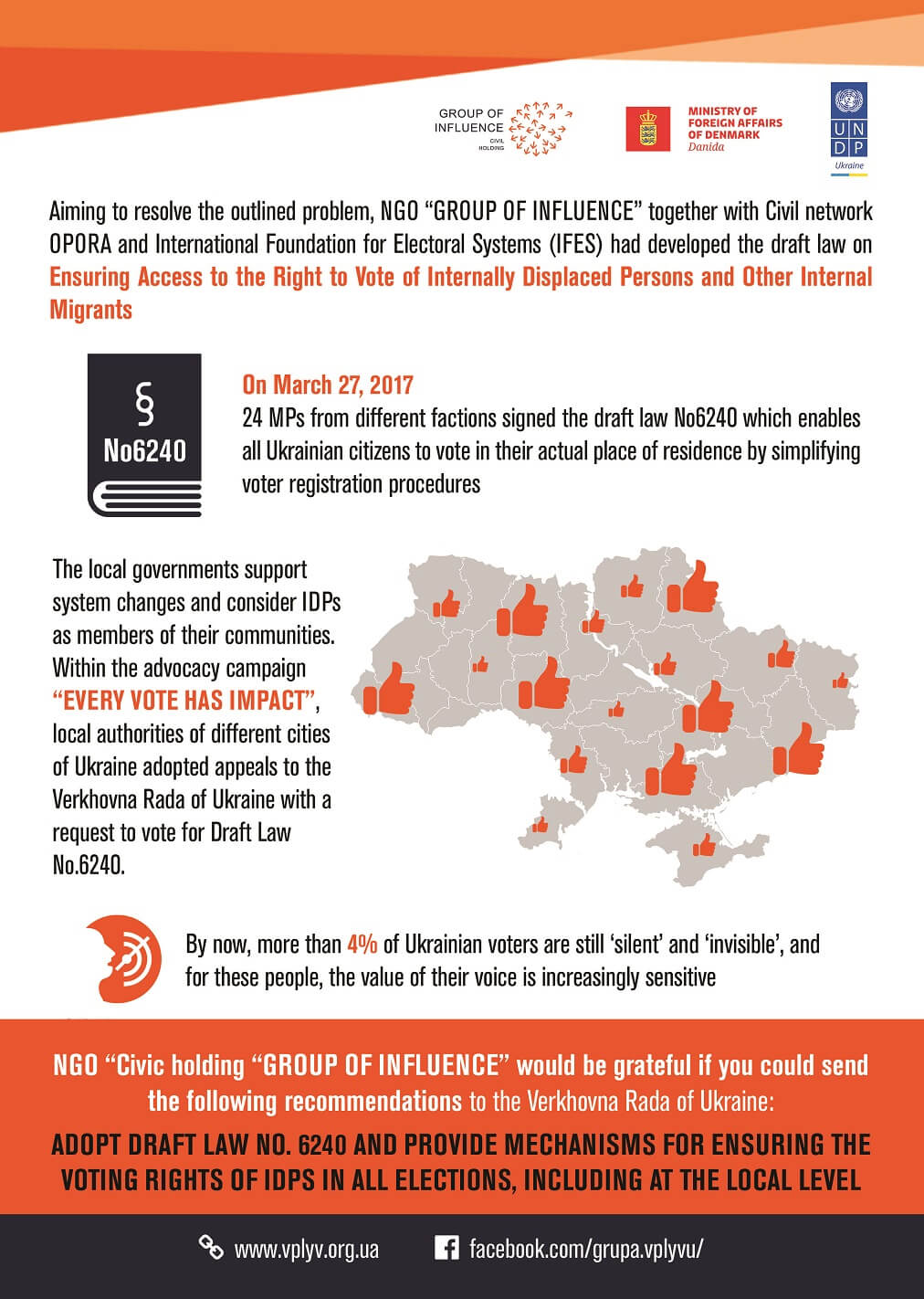
As a first concrete step, the Parliament of Ukraine should pass the draft Law No. 6240 in order to remove the existing barriers for IDPs’ full participation in elections, in line with international standards. “The long-awaited adoption of this draft law would simplify voter registration procedures and enable all Ukrainian citizens to register to vote at their actual place of residence,” said Congress Rapporteur Jos WIENEN (Netherlands, EPP/CCE) at a Conference organised today in Kyiv on voting rights of internally displaced persons at local level in Ukraine.
Besides legislation, there is also a need for better voter education and information for IDPs, ensuring quality voters’ lists and providing training for electoral authorities.
The Conference was also the occasion to share good practices from Georgia and Bosnia and Herzegovina and to address concerns expressed by local representatives over risks of election fraud, manipulation or pressure by underlining the existence of safeguards and tools to prevent abuse.
In a broader context, the participants also touched upon the issue of other groups of voters, such as migrant workers and students who are not residing in places where they are permanently registered, and thus disenfranchised. These groups, together with IDPs, face also continued obstacles to vote in the parliamentary as well as in the upcoming presidential elections. « Addressing all these problems would be of concrete benefit not only to those deprived of their voting rights but to Ukraine and its further democratic consolidation », concluded Congress Vice-President Barbara TOCE (Italy, SOC).
Representatives of Government, members of Parliament, the Central Election Commission, local and regional authorities, local NGOs, as well as national and international experts took part in the discussions together with Congress members.
Council of Europe
Ukrainian IDPs plan to vote! English subtitles. Social motivation video by NGO “Civil Holding GROUP OF INFLUENCE” and partners.
“Take your internal passport to your nearest office of the State Register of Voters on or before the 25th of March and apply to change your voting place. More details can be found online at: drv.gov.ua”
Short and long versions
The draft law is introduced by the members of Parliament of Ukraine
Nemyrya H. M., Nayyem М., Zalishchuk S. P., Chubarov R. А., Ryabchyn О. М., Shkrum А. І., Dzhemilev М., Chernenkо О. М., Yednak О. В., Sazhko S. М., Yefimov М. V., Veselova N. V., Lubinets D. V., Patskan V. V., Syumar V. P., Lohvynsky H. V., Ionova М. М., Lutsenko І. S., Ptashnyk V. Y., Hopko H. М., Popov І. V., Pavlenko Y. О., Taruta S. О., Yurynets О. V.
LAW OF UKRAINEOn Amending Certain Laws of Ukraine (Concerning the right to vote of internally displaced persons and other internal migrants)
The Verkhovna Rada of the Ukraine r e s o l v e s:
І. To amend the following laws of Ukraine:
1. The Law of Ukraine On State Register of Voters (The Official Bulletin of the Verkhovna Rada of Ukraine, 2007, № 20, p. 282):
1) The following amendments should be made to Article 8:
Part 2 of Article 8 should read as follows:
«2. The voter’s address shall be determined based on the registered place of residence of a voter as determined under the Law of Ukraine On Freedom of Movement and Freedom of Choice of Residence in Ukraine if this article does not specify other»;
2) Amend Part 3 to read as follows:
«3. Based on substantiated request of the voter, the Register of Voters Maintenance Body may determine other voter’s address than stipulated under Part 2 of this Article»;
3) Part 4 of Article 19 should read as follows:
«4. The voter’s address of a person that applied for his/her inclusion on the Register database shall be identified pursuant to the requirements of Parts 2, 4-7 of Article 8 hereof.»;
4) The following amendments should be made to Article 20:
Part 3 should read as follows:
«3. The request to change voter’s address specified in Part 3 of Article 8 of the Law may be filed by the voter to the Register Maintenance Body whose jurisdiction covers the territory to which the new voter’s address is assigned, prior to five days following the start of the election process or referendum process carried out on the territory within which the voter asks to define his new voter’s address. If the respective territory simultaneously holds several elections (referendum), such a request may be filed prior to five days following the start of the election (referendum) process of elections (referendum), held before the voting day in other elections taking place simultaneously.
In case of filing a request to change the voter’s address later than the fifth day following the start of the election process or referendum process (taking into account the specifics about the elections and the referendum held simultaneously provided for by paragraph one of this Part), the Register Maintenance Body adopts a substantiated decision not to alter the person’s voting address. A copy of the decision is sent to the voter no later than the day after the relevant decision is adopted along with simultaneous notification of the possibility to file the request to change voter’s address after the election process in the respective elections is finished.
In the case provided for in paragraph two of this Part, or if the timing of the respective electoral processes (referendum process) completely or partially overlap, the voter may file a request to change the voter’s address after completion of the electoral process, the voting day in which happens to be the last»;.
Part 4 should read as follows:
«4. If the voter applies for changing the voter’s address based on Part 3 of Article 8 of this Law, the voter shall attach a copy of the document confirming one’s actual residence address to the application referred to in Part 2 of this Article.
The voter justifies changing the voter’s address by one of the documents listed in Part 5 of this Article.»;
Part 5 should read as follows:
«5. The documents confirming the actual residence of the voter at the address specified in the application referred to in Part 2 of this Article, and properly justifying changing the voter’s address on the grounds provided for in Part 3 of Article 8 of the Law include:
1) lease contract at the address which the voter asks to define as his new voter’s address;
2) a document issued by the state or local authority certifying voter’s entrepreneurial activity at the address which the voter asks to define as his new voter’s address;
3) a document confirming the housing ownership at the address which the voter asks to define as his new voter’s address;
4) the IDP certificate;
5) document certifying voter exercising the care of a person whose residence is registered under the Law of Ukraine On Freedom of Movement and Freedom of Choice of Residence in Ukraine at the address which the voter asks to define as his new voter’s address;
6) a document certifying voter’s marital or family relationship with the person whose residence is registered under the Law of Ukraine On Freedom of Movement and Freedom of Choice of Residence in Ukraine at the address which the voter asks to define as his new voter’s address.»;
Part 6 should read as follows:
«6. The procedure of considering the voter’s appeal under Part 3 of Article 8 of this Law is established by the Central Election Commission.»;
Part 7 should read as follows:
«7. The Register Maintenance Body shall be entitled to check the change in the voter’s personal data specified in the application by consulting the bodies and institutions referred to in Article 22 hereof. If the grounds listed in Part 3 of Article 17 of this Law are in place, the head of the Register Maintenance Body shall issue an instruction for introducing the respective changes to the voter’s personal data in the Register, except for the case specified in Part 8 of this Article.»;
Part 13 should read as follows:
«13. The voter whose address was determined according to Part 3 of Article 8 of this Law may apply to the Register Maintenance Body with a new request to change voter’s address on the grounds provided by Part 3 of Article 8 hereof, no earlier than 180 days after the last voter’s address change was entered into Register.»;
Part 14 should read as follows:
«14. If the date of the appeal to the Register Maintenance Body referred to in Part 13 of this Article, the electoral process for the election of the President of Ukraine, parliamentary elections or local elections, national or local referendum process has commenced, voter’s address cannot be changed before the end of the relevant election or referendum process. If the timing of electoral processes (referendum process) completely or partially overlaps, the voter’s address cannot be changed before completion of the electoral or referendum process, the voting day in which happens to be the last.»;
Part 15 should read as follows:
«15. If the request of the voter referred to in Part 3 of Article 8 of this Law was submitted to the Register Maintenance Body prior to the reasons for changing the current voter’s address in accordance with the information provided for in Article 22 of this Law, voter’s address is determined in accordance with procedure established by Article 22 of this Law.»;
2. The Law of Ukraine Law of Ukraine On Local Elections (The Official Bulletin of the Verkhovna Rada of Ukraine, 2015, № 143-144):
1) Part 2 of Article 3 should read as follows:
«2. A document confirming the voter’s identity and Ukrainian citizenship at the local elections is:
1) a passport of the citizen of Ukraine;
2) a temporary ID of the Ukrainian citizen (for the persons who were recently granted the status of a Ukrainian citizen).»;
2) Part 3 of Article 3 should read as follows:
«3. A citizen’s belonging to the respective territorial community and his/her residence in the respective territory is determined based on his/her voter’s address (unless other is specified by law).»;
3. The Law of Ukraine On Ensuring of Rights and Freedoms of Internally Displaced Persons (The Official Bulletin of the Verkhovna Rada of Ukraine, 2015, № 1, p. 1):
1) Part 1 of Article 8 should read as follows:
«1. Internally displaced person shall enjoy his/her voting right at the elections of the President of Ukraine, members of Parliament of Ukraine, local elections and referenda in the manner prescribed by law».
IІ. Final and transitional provisions:
1. This Law shall be effective from the day following the day of its publication, and will come into force three months after its enactment.
2. The Central Election Commission shall:
1) ensure the adoption of the acts under the Law in the following month from the date of enactment of this Law;
2) bring its acts into conformity with this Law in the following month from the date of enactment of this Law;
3) ensure the functioning of the State Voter Register in accordance with this Law in the following three months from the date of enactment of this Law.
The Chairman of the Verkhovna Rada of Ukraine Parubiy А. V.
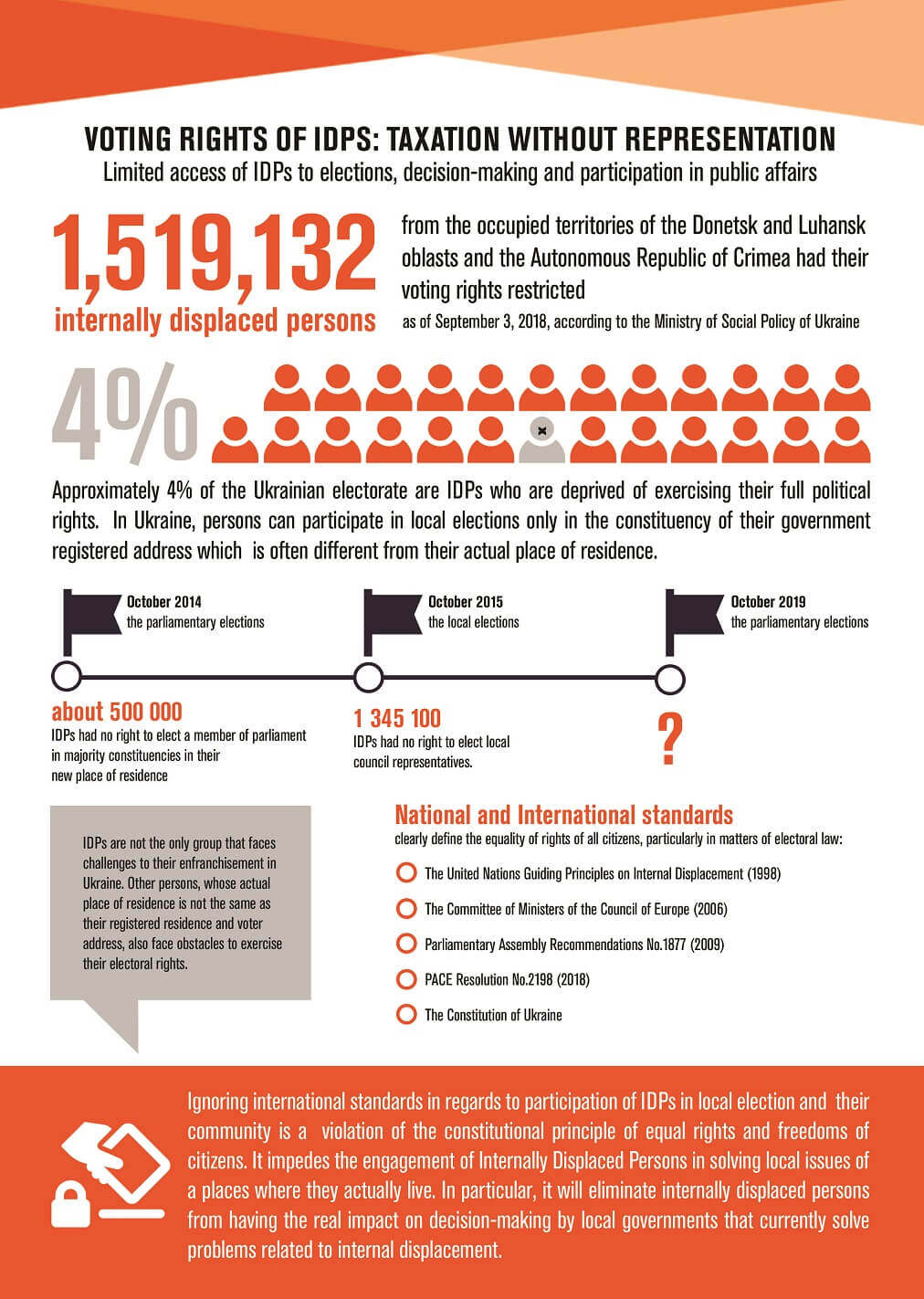
International organizations and bodies of state power of Ukraine estimate that internal migration is a significant factor in demographic, social, economic and political development of the country. According to research conducted by International organization of migration (IOM), there were more than 1.6 million internal migrants in 2014-2015, or 9% of economically active population. In addition, there is an upward trend in internal labor migration.
Annexation of Crimea and fighting in Donbas, in turn, have caused massive enforced internal displacement. According to the Ministry of Social Policy of Ukraine, more than 1.6 million internally displaced persons were registered as at February 2017.
Internal displacement from the temporarily occupied territories and other types of internal migration requires immediate actions of the state to ensure the principles of equality of constitutional rights and freedoms of all citizens and to stimulate social integration of these citizens at their new place of residence.
Public policy with regard to internal displacement and labor migration does not consider that the majority of internal migrants cannot change their place of registration for justified reasons. It has a negative effect on their constitutional rights and freedoms, in particular on the right to vote in all kinds of elections.
There are no constitutional limitations as to the right to vote related to the person’s place of registration, period of their residence in a particular community, or the system of registration. However, the electoral legislation contains provisions that complicate or make voting impossible to certain groups of citizens.
The right to vote in a local government election and parliamentary election by single-seat constituencies (from each electoral district) is imperatively linked to registering a place of residence in the electoral roll and to the existing registration system. It contains evidence of indirect discrimination and does not take into account the realms of internal migration, resulting in limited participation of large percentage of the population in voting.
The Constitution of Ukraine, the Law of Ukraine and the international standards in public policy in regards to internally displaced persons forbid all kinds of discrimination and other forms of restrictions of internally displaced persons in the exercise of their rights and freedoms.
The recommendations of international institutions and organizations are based on the provisions of the UN Guiding principles on internal displacement. In particular, Principle 22 of the Guidelines stipulates that internally displaced persons shall not be discriminated against as a result of their displacement in the enjoyment of their rights to: associate freely and participate equally in community; to vote and to participate in governmental and public affairs, including the right to have access to the means necessary to exercise this right.
Ignoring international standards in regards to participation of internally displaced persons in local election and in community contains sins of violation of the constitutional principle of equal rights and freedoms of citizens. It impedes the engagement of internally displaced persons in solving local issues of the places where they actually live. In particular, it will eliminate internally displaced persons from having the real impact on decision-making by local governments that currently solve problems related to internal displacement.
Hence, the Law on State Register of Voters of Ukraine, the Law on Local Elections, and other legislative acts of Ukraine do not fully respect the right to vote of internally displaced persons and other internal migrants and require amendments that would guarantee non-discriminatory conditions for all citizens to execute the right to vote. Electoral legislation should also take into account the need to address formal obstacles and difficulties related to internal displacement/internal migration, which occur to internally displaced persons in exercising their constitutional rights and freedoms.
Therefore, the draft Law of Ukraine on Ensuring Access to the Right to Vote of Internally Displaced Persons and Other Internal Migrants suggests the means to eliminate the citizens’ rights violations and bring existing legislation into compliance with the Constitution of Ukraine and the International Electoral Standards.
Implementation of the draft law, in case of its approval by Verkhovna Rada of Ukraine, will allow:
– Internally displaced persons and other internal migrants to execute their right to vote in local elections;
– To prevent discrimination based on registration by place of residence and that on a regional basis in executing the right to vote and other rights;
– To bring Ukrainian law into compliance with international standards relevant to internally displaced persons, labor migrants and other categories of citizens;
– To create favorable conditions in the integration of internally displaced persons and their equal participation in managing issues at the regional and national levels.
– To reduce social tension in the interaction between public authorities and internal migrants.
This draft law was developed by the experts of the Civil Network “OPORA”, NGO “Public holding “Group of influence”, the International Foundation for Electoral Systems (IFES), members of parliament of Ukraine, along with the representatives of the following NGOs: Donbas SOS, the Human Rights Information Centre, Crimea SOS, and the two charitable foundations – The Right to Protection and Vostok-SOS.
Members of the Interagency Working Group on Improving National Legislation on the Protection of the Human Rights of Internally Displaced Persons in the Ministry of temporarily occupied territories and IDPs (including representatives of the UN Refugee Agency and the Council of Europe) took part in the discussion of the draft law.
Article 8.Voter’s address
The voter’s address shall mean the address of a voter’s residence, place of stay or any other address substituting the address of a voter’s residence that shall serve as grounds for assigning of the voter to the respective election precinct.
The voter’s address shall be determined based on the registered place of residence or domicile of a voter as determined under the Law of Ukraine on Freedom of Movement and Freedom of Choice of Residence in Ukraine if this article does not specify other.
Based on substantiated request of the voter, the Register of Voters Maintenance Body may determine other voter’s address than stipulated under the second paragraph of this article.
The voter’s address of a military serviceman on conscription shall be the address under which the military unit is deployed.
The voter’s address of a voter serving a criminal sentence in the forms of arrest, imprisonment or restriction of freedom shall be the address of the penitentiary institution.
The voter’s address of a voter residing or staying abroad shall be the voter’s mailing address in the country of residence or stay.
The voter’s address shall include the data specified in paragraphs 1-9, 11 (for the voters residing or staying in Ukraine) or the data specified in paragraphs 1, 2, 10 (for the voters residing or staying abroad) of this Part of the Article, as follows:
1) the country of residence or stay;
2) the region of Ukraine as specified in Part 2 of Article 133 of the Constitution of Ukraine, or subnational administrative unit (state, province, land) of the foreign country in which a voter resides or stays;
3) the rayon or the city of regional or republican (in the case of Autonomous Republic of Crimea) subordination into which the community is included
4) the community (city, settlement or village);
5) the street (avenue, boulevard, square, lane, quarter, corner, etc.);
6) the house number,
7) the number of a building’s part (wing, block, section, etc.);
8) the number of an apartment or room;
9) the postal code:
10) the mailing address of a voter under the postal standards of the country of residence or stay; and
11) other data determining the voter’s address.
Article 19. Procedure for a person turning to Register Maintenance Body upon his/her own initiative for inclusion on Register
A person who received the right to vote, as well as a person who has the right to vote but identified himself/herself as missing on the Register database, shall have the right to apply for inclusion on the Register upon his/her own initiative to the Register Maintenance Body whose jurisdiction covers the territory of Ukraine to which his/her voter address is assigned.
A person referred to in Part 1 of this Article shall submit to the Register Maintenance Body a written application (the template for which shall be a subject to approval by the Administrator of the Register) containing personal data specified in Article 6, paragraph 1 of Part 1 of Article 7 hereof, and present documents certifying the identity of the person in question and his/her citizenship, – the passport of a Ukrainian citizen or temporary certificate of the citizen of Ukraine (in the case when the person recently acquired Ukrainian citizenship), – with a copy of the that document attached thereto. The information on a voter’s permanent inability shall be specified by the voter himself/herself in the application that shall be submitted together with the document that proves a permanent inability to move. To file an application, a person being on military service on conscription shall be given a leave for the period necessary to file an application to the Register Maintenance Body.
A person who received the right to vote and at the time when that right was received was residing or staying abroad, shall have the right to file with the diplomatic institution of Ukraine whose jurisdiction covers the territory in which a person resides or stays an application for inclusion on the Register database prepared according to the requirements of Part 2 of the present Article. The application shall be accompanied by the copy of the presented document certifying the identity and citizenship of the voter, namely, the passport for travelling abroad, diplomatic or service passport, or temporary certificate of a Ukrainian citizen (in the case when the person recently acquired Ukrainian citizenship). The head of the Ukrainian diplomatic institution abroad shall without delay forward the application to the Register Maintenance Body at the Ministry of Foreign Affairs of Ukraine.
The voter’s address of a person that applied for his/her inclusion on the Register database shall be identified pursuant to the requirements of Parts 2, 4-7 of Article 8 hereof.
The Register Maintenance Body shall check whether the person who applied for inclusion on the Register have not been already included on the Register and, if necessary, shall check the information specified in the application and needed for making an entry to the Register database through consultation with the bodies and institutions referred to in Article 22 hereof.
If the conditions specified in Part 2 of Article 17 hereof are met, the head of the Register Maintenance Body shall issue an instruction for making an entry to the Register database. Before issuing such an instruction, the Register Maintenance Body shall have the right to verify the data on a voter with the voter in question directly.
If the voter was included on the Register database, the Register Maintenance Body shall forward to the postal address of the voter a notification of his/her inclusion, prepared based on a template approved by the Administrator of the Register. The notification shall specify the personal data of the voter referred to in Part 1 of Article 6 and Part 1 of Article 7 hereof, as well as the date of the voter’s inclusion on the Register database. The notification shall be signed by the head of the Register Maintenance Body and stamped by the seal of that body.
If a voter has already been included on the Register, the notification specified in Part 7 of this Article shall be sent to the address identified by the voter in question as his/her voter’s address.
The head of the Register Maintenance Body shall turn down the application of a person referred to in Part 1 and Part 3 of this Article if:
1) it has been revealed that the person in question does not have the right to vote; or
2) during the checks referred to in Part 5 of this Article, discrepancies between the data specified in a voter’s application and information received from the respective body or institution have been identified.
A person who was refused inclusion on the Register database shall be notified thereof in written, providing that the exhaustive list of grounds for non-inclusion is specified. Such a notification shall be sent to the address identified by the voter in question as his/her voter’s address.
Article 20. Procedure for a voter turning to Register Maintenance Body upon his/her own initiative for changing his/her personal data
In case of a change of the personal data referred to in the Part 1 of Article 6 or paragraphs 1 and 4 of Part 1 of Article 7 hereof, a voter shall have the right to personally apply to the Register Maintenance Body whose jurisdiction covers the territory to which the voter’s address is assigned with an application for changing his/her personal data on the Register. An application shall be accompanied by the documents (or their copies) proving those changes. If the application is accompanied by copies of the documents, the original documents shall be presented to the Register Maintenance Body. A voter with a permanent inability to move without assistance shall have the right to authorize another person to submit the documents on his/her behalf. A voter living or residing abroad shall file the application to the respective diplomatic institution of Ukraine, which shall without delays forward the application with the documents (or their copies) attached thereto to the Register Maintenance Body at the Ministry of Foreign Affairs of Ukraine.
In the case of changing a voter’s address, a voter shall submit the application for changing the voter’s address with the documents (copies of the documents) proving the change of the voter’s address attached thereto to the Register Maintenance Body whose jurisdiction covers the territory to which the new voter’s address is assigned.
The request to change voter’s address specified in Part 3 of Article 8 of the Law may be filed to the Register Maintenance Body whose jurisdiction covers the territory to which the new voter’s address is assigned, prior to five days following the official start of the election processor referendum process carried out on the territory within which the voter asks to define his new voter’s address. If the respective territory simultaneously holds several elections (referendum), such a request may be filed prior to five days following the official start of the election (referendum) process of elections (referendum), held before the voting day in other elections taking place simultaneously.
In case of filing a request to change the voter’s address later than the fifth day following the official start of the election processor referendum process (taking into account the specifics about the elections and the referendum held simultaneously provided for by paragraph one of this Part), the Register Maintenance Body adopts a substantiated decision not to alter the person’s voting address. A copy of the decision is sent to the voter no later than the day after the relevant decision is adopted with simultaneous notification of the possibility to file the request to change voter’s address after the election process in the respective elections is finished.In the case provided for in paragraph two of this Part, or if the timing of electoral processes (referendum process) completely or partially overlap, the voter may file a request to change the voter’s address after completion of the electoral process, the voting day in which happens to be the last.
If the voter applies for changing the voter’s address in the Register database based on Part 3 of Article 8 of this Law, the voter shall attach a copy of the document confirming one’s actual residence address to the application referred to in Part 2 of this Article.
The voter justifies changing the voter’s address by one of the documents listed in Part 5 of this Article.
The documents confirming the actual residence of the voter at the address specified in the declaration referred to in Part 2 of this Article, and properly justifying changing the voter’s address on the grounds provided by Part 3 of Article 8 of the Law include:
1) lease contract at the address, the voter asks to define as his new voter’s address;2) a document issued by the state or local authority certifying voter’s entrepreneurial activity at the address, the voter asks to define as his new voter’s address;3) a document confirming the housing ownership at the address, the voter asks to define as his new voter’s address; 4) the IDP certificate;5) document certifying voter exercising the care of a person whose residence is registered under the Law of Ukraine on Freedom of Movement and Freedom of Choice of Residence in Ukraine at the address, the voter asks to define as his new voter’s address;6) a document certifying voter’s marital or family relationship with the person whose residence is registered under the Law of Ukraine on Freedom of Movement and Freedom of Choice of Residence in Ukraine at the address, the voter asks to define as his new voter’s address.
The procedure of considering the voter’s appeal under Part 3 of Article 8 of this law is established by the Central Election Commission.
The Register Maintenance Body shall be entitled to check the change in the voter’s personal data specified in the application by consulting the bodies and institutions referred to in Article 22 hereof. If the grounds listed in Part 3 of Article 17 of this Law are in place, the head of the Register Maintenance Body shall issue an instruction for introducing the respective changes to the voter’s personal data in the Register database, except for the case specified in Part 8 of this Article.
. If a voter applies for changing the voter’s address in the Register database, the Register Maintenance Body shall check whether the application is substantiated. Based on results of such a check, the head of the Register Maintenance Body shall be entitled to adopt one of the following decisions:
1) to issue an instruction to change the voter’s address in the Register database (if the voter’s address is changed to an address within the territory of jurisdiction of this Register Maintenance Body);
2) to apply, through the automatized information and telecommunications system of the Register, a request for changing the voter’s address to the Register Maintenance Body whose jurisdiction covers the territory to which the previous voter’s address has been assigned (if the previous voter’s address is not assigned to the territory covered by the jurisdiction of this Register Maintenance Body); or
3) to refuse the voter to change his/her voter’s address.
In the case of changing the personal data on the Register database, the Register Maintenance Body that made such a change shall notify the voter on the made change in writing.
The head of the Register Maintenance Body shall turn down the voter’s application referred to in Parts 1 or 2 of this Article based on the following grounds:
1) if it has been identified that the person who submitted an application is missing in the Register database;
2) if during the check referred to in Part 3 of this Article, discrepancies between the data specified in the application and the data received from the respective bodies or institutions have been identified;
3) if the application for changing the voter’s address was not found substantiated; or
4) if it has been identified that the requested changes in the personal data of the voter have already been made.
The person who applied with an application referred to in Part 1 or Part 2 of this Article, shall be notified in written on turning the application down, providing that the exhaustive list of grounds for turning down the application is specified in notification. Such a notification shall be sent to the voter’s address of the voter in question. In the case of refusal to change the voter’s address, such a notification shall be sent to the voter’s address specified in the Register database and to the address which the voter in question asked to recognize as his/her new voter’s address.
If it has been identified that the person who submitted the application specified in Part 1 or Part 2 of this Article was not included on the Register database, the Register Maintenance Body shall check the data specified in the application by requesting confirmation from the bodies and institutions listed in Article 22 of this Law. A decision to include the voter on the Register database shall be made pursuant to the requirements of Part 6 and Part 7 of Article 19 hereof. Before making such a decision, the Register Maintenance Body shall be entitled to apply to the voter in question with a request for updating the data on such a voter.
13. The voter whose address was determined according to Article 8 of the Law may apply to the Register Maintenance Body with a new request to change voter’s address on the grounds provided by Part 3 of Article 8 hereof, no earlier than 180 days after the last voter’s address change was entered into Register.
If the date of the appeal to the Register Maintenance Body referred to in paragraph 13 of this Article, the electoral process for the election of the President of Ukraine, parliamentary elections or local elections, national or local referendum process has commenced, voter’s address can not be changed before the end of the relevant election or referendum process. If the timing of electoral processes (referendum process) completely or partially overlap, the voter may file a request to change the voter’s address after completion of the electoral process, the voting day in which happens to be the last.
If the request of the voter referred to in Article 8 of the Law was submitted to to the Register Maintenance Body prior to the reasons for changing the current voter’s address in accordance with the information provided for in Article 22 of this Law, voter’s address is determined in accordance with procedure established by Article 22 of this Law.
Law of Ukraine On Local ElectionsArticle 3. Universal suffrage
A document confirming the voter’s identity and Ukrainian citizenship at the local elections:
1) a passport of the Ukrainian citizen;
2) a temporary ID of the Ukrainian citizen (for the persons who were recently granted the status of a Ukrainian citizen).
A citizen’s belonging to the respective territorial community and his/her residence in the respective territory is determined based on his/her voter’s address (unless other is specified by the Law).
Law of UkraineOn Ensuring of Rights and Freedoms of Internally Displaced PersonsArticle 8. Ensuring voting rights of internally displaced persons
Internally displaced person shall enjoy his/her voting right at the elections of the President of Ukraine, members of Parliament of Ukraine, local elections and referenda in the manner prescribed by law
Final and transitional provisions
This Law shall be effective from the day following the day of its publication, and will come into force three months after it become effective.
The Central Election Commission shall:
in the following month from the date of enactment of this Law – ensure the adoption of the acts under the Law;
in the following month from the date of enactment of this Law – bring its acts into conformity with this Law;
in the following three months from the date of enactment of this Law – ensure the functioning of the State Voter Register in accordance with this Law.