Alexandr Korenkov – Громадський холдинг "ГРУПА ВПЛИВУ"
Skip navigation

Providing housing for internally displaced persons (IDPs) remains one of the key challenges for the state policy on human rights protection during the armed aggression against Ukraine. Having their own housing means a lot more than just a basic need; it’s also a key factor for social stability, economic capacity, and psychological adaptation of IDPs in new communities. The preferential mortgage loan programme under the «Housing solutions for internally displaced persons» project (KfW) turned out to be one of the few ways to help IDPs buy their own homes.

This was made possible by a number of key advantages:

  • mortgage is granted for a term of up to 30 years (but no longer than until the borrower reaches the age of 65);
  • interest rate is 3 % per annum;
  • borrower’s own (initial) contribution is 6 % of the cost of the housing;
  • mortgage is provided for the purchase of finished housing on the secondary market, built no more than 50 years ago or renovated no more than 35 years ago;
  • participants in the programme choose the housing themselves – the standard area is 52.5 m² per family of 1–2 people and an additional 21 m² for each subsequent family member.

Citizens who are registered as internally displaced persons, have a confirmed source of official income, do not own housing (except for housing located in temporarily occupied territories or in areas of active hostilities), and have not participated in other state housing programmes after reaching the age of majority are eligible to participate in the programme. Candidates register via the Diia web portal. The selection of participants who are eligible for receiving a mortgage is carried out by random sampling using special software developed by an international implementation consultant and approved by the KfW development bank. The programme has a revolving fund, meaning that returned funds serve for new mortgages. As of July 2025, the programme covered 1,053 IDP families out of 35,700 registered for receiving a preferential loan, indicating limited access to this instrument despite high demand. That is why conducting research is an important condition for improving preferential mortgage loan programmes and considering opportunities for their further expansion. The research provides a deeper understanding of how the programme has affected various aspects of borrowers’ lives, including housing conditions, emotional well-being, financial stability, access to services, needs met, and integration into host communities. The relevance of this analysis is growing in the context of planning long-term decisions for IDPs and the need for sustained support for state programmes.

The research was conducted by NGO «Civil holding «GROUP OF INFLUENCE» with financial support from the Council of Europe as part of the Council of Europe project «Facilitating housing solutions for the war-aff ected people in Ukraine. Phase II», which is implemented under the Council of Europe Action Plan for Ukraine «Resilience, Recovery, and Reconstruction» 2023–2026.

In 2014, Russia launched a war against Ukraine, which began with the occupation of the Crimean Peninsula. For more than 12 years, part of our country’s territory has been under Russian control. Millions of Ukrainian citizens live in danger every day because of the occupation. Russia unlawfully detains and tortures thousands of civilians, abducts, militarises and indoctrinates Ukrainian children, imposes its own citizenship on the residents of the territories it has seized, confiscates property and commits other crimes, turning them into daily practices. People under occupation live in conditions of daily coercion and the absence of a state that can protect their rights. Despite this, Ukrainian citizens under occupation resist every day.

This resistance reminds the world of Russia’s crime of aggression and calls upon active, coordinated and real action from democratic countries where human rights are not just empty words. History proves once again that appeasing an aggressor encourages them to commit even more crimes.

We, representatives of civil society organisations dealing with the protection of the rights of victims of war, including residents of the temporarily occupied territories,

consider that the only reason for the prolonged occupation of part of Ukraine’s territory is the aggression of the Russian Federation. The only way to protect our citizens living in the temporarily occupied territories of Ukraine is to completely de-occupy these territories and restore Ukrainian state authority over them;

affirm that the duration of the occupation does not make it normal, and we have no right to become accustomed to people’s suffering and to devalue their fight by remaining silent;

acknowledge that while the occupation continues, our people remain — those living in cities and villages seized by the Russian Federation and those who have been forced to leave. These people require systematic state support and protection;

insist that Ukraine should maintain ties with the residents of the temporarily occupied territories, provide comprehensive assistance for their relocation, and create conditions for their reintegration into the territories controlled by the Ukrainian government;

are convinced that measures to ensure national security must take into account the conditions in which Ukrainian citizens live and should not be used as a justification for excessive restrictions on the rights of residents of the temporarily occupied territories;

emphasise that it is important to speak about the temporarily occupied territories and the people who live there in a balanced and responsible manner, without politicising or stigmatising the experience of living under occupation. It is important to avoid statements that create prejudice or hostility, and instead send a clear message to citizens under occupation: Ukraine remembers them, will not abandon them, and is working to protect them and return their territories;

call upon international partners to ensure support for the Defence Forces of Ukraine and the protection of civilians throughout the entire sovereign territory of Ukraine, and to oppose pressure on the Ukrainian authorities to agree to an expansion of territories occupied by the Russian Federation.

The Manifesto is open for signature.

Support it and join the collective position in defence of Ukrainian citizens living under temporary occupation.

The Manifesto can be signed here until 1 March 2026.

After the collection of signatures is completed, the Manifesto will be submitted to the Office of the President of Ukraine, the Cabinet of Ministers of Ukraine, the Verkhovna Rada of Ukraine and other state authorities and international partners of Ukraine.

Every signature matters.

NGO Civil holding GROUP OF INFLUENCE

The Human Rights Centre ZMINA

NGO Donbas SOS

CF EAST-SOS

CF Right to Protection

NGO Crisis Insight

NGO CrimeaSOS

CO Stabilization Support Services

Crimean Human Rights Group

The “Yellow Ribbon” civil resistance movement against the occupation

February 2026 marks 12 years since the Russian Federation launched its armed aggression against Ukraine. Nearly 20% of Ukraine’s territory remains under occupation, and every day the occupying state continues its military offensive, destroying Ukrainian cities and killing Ukrainian civilians and military personnel. Despite all the “peace initiatives” of 2025, the Russian Federation shows no intention of ending the war against Ukraine and its citizens. Moreover, the Russian Federation is doing everything it can to continue this war and destroy the ties between the residents of the temporarily occupied territories (hereinafter – TOT) and Ukraine. According to the UN Human Rights Monitoring Mission in Ukraine, 2025 was the deadliest year for the civilian population in Ukraine since 2022, with the level of casualties 70% higher than in 2023. In view of this, the development of policies aimed at protecting the rights of war victims and maintaining ties with residents of the TOT of Ukraine remains an urgent need for the state.

Overcoming the consequences of hostilities, shelling of Ukrainian settlements, and  especially residential and energy infrastructure, which continue in 2026,  requires further joint action by the state, civil society, and international partners. Efforts must also be made to ensure justice for war victims – the harmonisation of national criminal legislation with international law, as well as the recording and compensation of all damage caused by the occupying state, remain pressing issues.

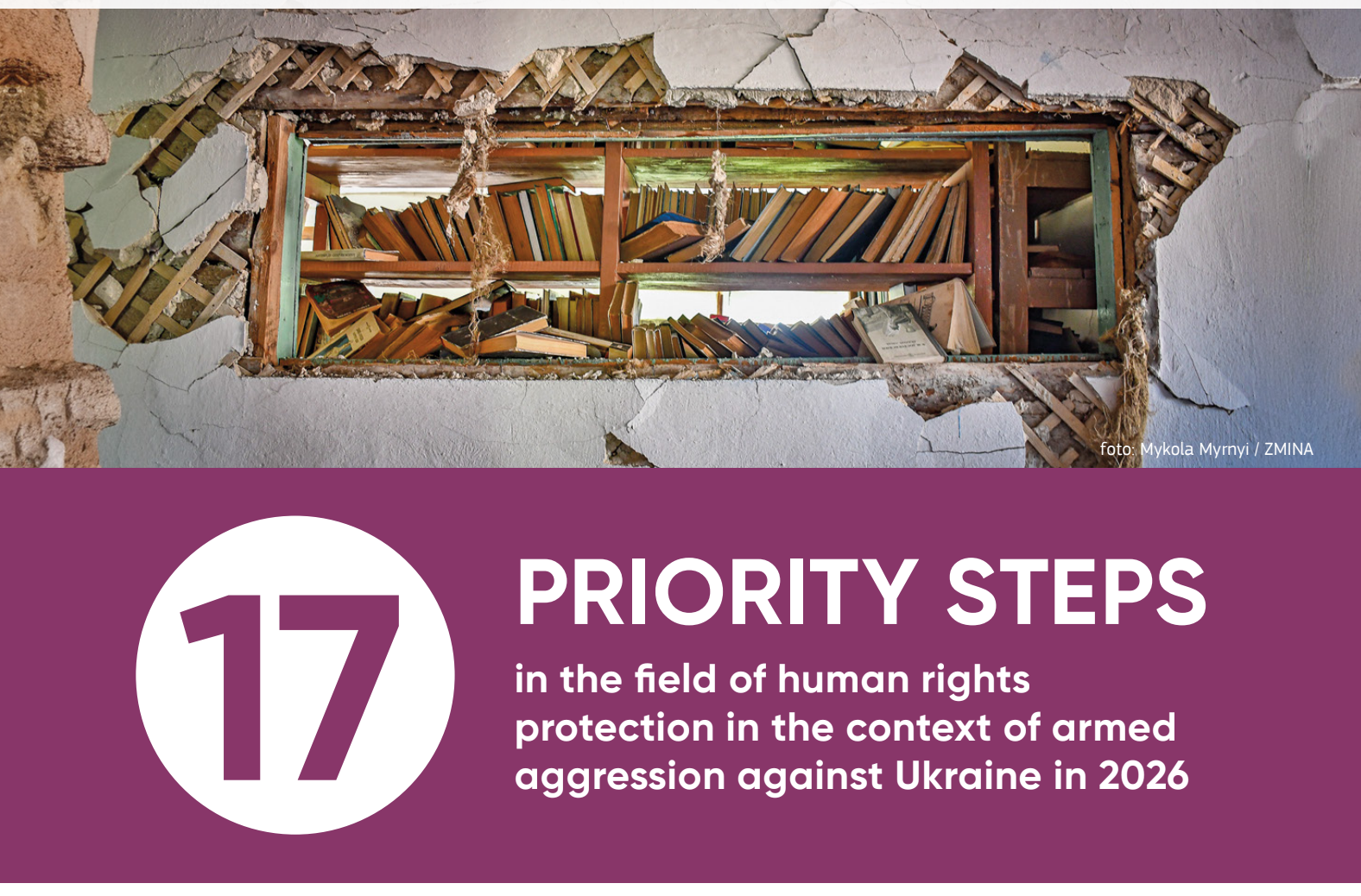
We, representatives of a coalition of organisations dealing with the protection of the rights of victims of armed aggression against Ukraine, present a consolidated position on the state’s priority steps in the field of human rights protection in 2026. The implementation of the recommendations below will ensure a consistent and predictable state policy towards war victims.

To the President of Ukraine: 

1. Promote the issue of protecting the rights of victims of armed aggression by the Russian Federation, in particular residents of the TOT of Ukraine, in the negotiation process. The prolonged occupation of a significant part of Ukraine’s territory is leading to a deterioration in the situation of Ukrainian citizens who remain there. Currently, negotiations, information about which is available in the media, include mention of three vulnerable categories of citizens: prisoners of war, illegally imprisoned civilians, and children deported or forcibly displaced by the Russian Federation. At the same time, Russia systematically violates human rights on a daily basis in the occupied territories of Ukraine. The Russian Federation imposes its citizenship, denies access to essential services, implements a policy of mass nationalisation of property, kidnaps, imprisons and tortures civilians who remain under occupation. The practices of indoctrination and militarisation of Ukrainian children in the TOT are systematic. The occupying state is conducting forced mobilisation of Ukrainian citizens into the ranks of the Russian Armed Forces, which creates conditions for Russia to continue the war. It is obvious that only the complete de-occupation of Ukraine’s territory will enable the restoration and protection of the rights of Ukrainian citizens. At the same time, as long as the occupation continues, the occupying state is obliged to ensure compliance with the norms of international humanitarian law (hereinafter – IHL). Therefore, it is necessary that part of the negotiations with Russia on ending the war (a truce, a “freeze”, a ceasefire or other process, regardless of its name) should include ensuring basic conditions for residents of the temporarily occupied territories of Ukraine. Part of the peace agreements should be guarantees of unhindered departure from the TOT of Ukraine and protection of the rights of Ukrainian citizens residing in the TOT of Ukraine, in accordance with international law, access for national and international humanitarian organisations and monitoring missions to document human rights violations, ensure the search for missing persons, and provide safe and effective humanitarian assistance. 

2. Prioritise the development of state policy regarding victims of armed aggression against Ukraine. As of early 2026, the state does not have a comprehensive strategy or vision for ensuring the rights of victims of the Russian Federation’s armed aggression, in particular those who have suffered damage to their lives and health. This situation is a consequence of the absence of an authorised body within the Cabinet of Ministers of Ukraine responsible for the formation and implementation of state policy in the field of protection and support for persons affected by the armed aggression against Ukraine. Until the beginning of 2025, this body was the Ministry for Reintegration of Temporarily Occupied Territories of Ukraine (hereinafter – the Ministry for Reintegration). After its liquidation, its powers and responsibilities were scattered among ministries, and some powers were lost (e.g., the formation of transitional justice policy). Each of the central executive bodies currently exercises separate, fragmented powers in relation to the affected population within its own mandate, effectively in a vacuum, without proper coordination, common goals or a unified vision. Most of the powers after the liquidation of the Ministry for Reintegration were transferred to the Ministry for Development of Communities and Territories (hereinafter – the Ministry for Development). However, in the ministry responsible for infrastructure restoration and regional policy, the affected population is not and cannot be a priority due to the significant number of other urgent tasks. It is therefore important to rethink the institutional “architecture” for the formation and implementation of state policy towards victims of the war. 

3. Ensure coordination of the safe departure of children and young people from the temporarily occupied territories of Ukraine and introduce a model for their comprehensive support and reintegration. Despite the prolonged occupation, support for children and young people from the temporarily occupied territories of Ukraine remains fragmented at all stages: from preparing and carrying out their departure from the occupation to their adaptation and integration in the territory controlled by the Ukrainian government. At the same time, the departure from the TOT of Ukraine is accompanied by increased security risks (filtering procedures, psychological pressure and the risk of detention), significant financial costs in the absence of reliable information about routes and further support tools. In cooperation with international partners and foreign governments, it is important to prioritise the issue of comprehensive, continuous individual support for children and young people from the TOT of Ukraine during their departure, and to provide information, financial and logistical support, etc. At the same time, at the national level, it is necessary to initiate the development and implementation of a unified comprehensive model for the support and reintegration of children and young people after leaving the TOT of Ukraine. Such a model should provide, in particular, for a clear and rapid procedure for restoring or issuing documents certifying identity and confirming Ukrainian citizenship; mentoring programmes; and assistance with integration into the legal, social, educational, cultural, economic and information spaces of Ukraine. Given the acute demographic crisis and long-term needs for Ukraine’s recovery, the preservation and return of human capital, including the departure of children and young people from the TOT of Ukraine to the territory controlled by the Government of Ukraine, should be considered as one of the components of national resilience and the future of Ukraine.

4. Develop a balanced security strategy for the TOT of Ukraine and Ukrainian citizens residing there, taking into account the objectives of reintegration and social cohesion. At the national level, there is no security policy in place regarding the TOT of Ukraine and Ukrainian citizens who remain in these territories for a long time. In the absence of such a policy, the actions of the state and its actors, particularly in the field of national security, are sporadic, unpredictable and dangerous for Ukrainian citizens. Such policies often contradict public statements about the importance of maintaining ties with Ukrainian citizens in the occupied territories. These discrepancies lead to prejudice against residents of the TOT of Ukraine or Ukrainian citizens who originate from the TOT. This creates an image of a threat allegedly posed by Ukrainian citizens who reside in or have left the occupied territories. As a result, initiatives are being introduced at the state level that cause or reinforce negative perceptions of residents of the TOT of Ukraine and create risks of violating the rights of citizens living under occupation. For example, the law on multiple citizenship poses risks to the preservation of Ukrainian citizenship for residents of the TOT of Ukraine; the government’s initiative to require polygraph testing for those who are likely to have Russian citizenship obtained during the occupation imposes disproportionate restrictions on access to public service and creates risks of violating the right not to testify against oneself and the right to legal assistance. It is common practice to refuse to issue certificates for return to Ukraine or Ukrainian passports to residents of the TOT of Ukraine after their return as a measure to ensure national security. It is important to conduct a comprehensive analysis of the risks associated with people living in the TOT of Ukraine and to develop a holistic state vision, taking into account the conditions created by the occupying authorities in the TOT of Ukraine, awareness of the consequences of prolonged occupation, and recognition of the experience of Ukrainian citizens who have been living under occupation for a long time. An important component of this policy should be a strategic framework for preserving and strengthening social cohesion in Ukraine as an element of national security and a key condition for reintegration. 

To the Verkhovna Rada of Ukraine:

5. Establish mechanisms for the use of information contained in documents issued under occupation. The state’s approach to documents issued in the TOT of Ukraine is based on the principle of their complete non-recognition in accordance with Article 9 of the Law of Ukraine “On Ensuring Rights and Freedoms and the Legal Regime in the Temporarily Occupied Territories of Ukraine”. An exception applies to documents confirming the fact of birth, death, and registration (dissolution) of marriage of a person in the TOT of Ukraine. However, even for these documents, recognition is possible only through court proceedings, which are lengthy, complex, and costly. During almost 12 years of occupation, millions of documents of various kinds have been issued in the TOT of Ukraine. In addition to civil status records, these include medical documents, education documents, property rights documents, court decisions, and documents confirming insurance (work experience) and wages, etc. Complete disregard of these documents and failure to take into account the information they contain creates barriers or makes it impossible for Ukrainian citizens to exercise their rights, and also significantly complicates reintegration after leaving the TOT of Ukraine. The state is effectively shifting all the negative consequences of the occupation onto the citizens themselves, which contradicts both IHL and the strategic goal of maintaining ties with the residents of the TOT of Ukraine. Therefore, the state must move from a policy of complete non-recognition of documents to a legally defined approach that provides for clear and transparent mechanisms for using information from certain categories of documents issued during the occupation, taking into account security factors. This approach should minimise harm to the rights and freedoms of Ukrainian citizens, reduce the burden on the judicial system, simplify preparations for de-occupation, and promote the effective reintegration of the TOT of Ukraine. The recognition of information from documents issued in the TOT of Ukraine should also be seen as part of memorialising and documenting the experience of occupation, both to preserve the evidence base, establish historical truth, and compensate for the damage caused.

6. Ensure the proper functioning of the national compensation mechanism for residential properties destroyed or damaged as a result of armed aggression against Ukraine. In the context of large-scale attacks by the Russian Federation on residential infrastructure, the national compensation mechanism is of particular importance as a tool for supporting victims whose homes have been destroyed or damaged as a result of the Russian Federation’s armed aggression. The availability of such support is a necessary element of recovery, prevention of further waves of displacement, and creation of preconditions for the return of Ukrainian citizens from abroad. At the same time, the compensation mechanism introduced by Law of Ukraine No. 2923-IX, despite its prompt launch in 2023 and practical results, does not provide for compensation for owners of housing that, as of 24 February 2022, was located in the TOT of Ukraine and was destroyed or damaged before the start of the full-scale invasion by the Russian Federation. To address these gaps, it is necessary to adopt Draft Law No. 13136, which expands the temporal and territorial scope of access to the national compensation mechanism and broadens the circle of eligible beneficiaries. In 2025, a governmental initiative introducing housing vouchers for internally displaced persons (hereinafter – IDPs) from the TOT of Ukraine who are combatants and persons with war-related disabilities was launched as a further component of the national compensation mechanism. However, if financial resources are available, it would be advisable to extend it to other categories of IDPs whose homes remain in the temporarily occupied territories of Ukraine and are located in settlements that have become uninhabitable. An additional systemic barrier to the compensation mechanism is the lack of information about property rights in the State Register of Property Rights to Immovable Property (hereinafter – the State Register). This makes it impossible for a significant number of victims to receive compensation. According to the Ministry for Development, approximately 9.6 million persons are unverified housing owners. Entering information into the State Register on ownership of housing acquired before 1 January 2013 is complicated by the lack of access to the archives of the Bureau of Technical Inventory (hereinafter – BTI) and is reduced to lengthy and financially burdensome court proceedings. To resolve this issue, it is necessary to adopt draft law No.11440 in the second reading and simplify  the judicial procedure for confirming ownership rights. At the same time, applicants in this category of cases should be exempted from paying court fees, and these cases should be removed from civil proceedings and transferred to separate proceedings.

7. Amend the Criminal Code of Ukraine to ensure compliance with the principles of legal certainty and proportionality in matters of liability for collaborative activities. Since March 2022, new articles have been added to Ukrainian criminal law: “collaborative activity” (Article 111-1) and “aiding an aggressor state” (Article 111-2). An analysis of the practice of prosecuting collaborative activity (a total of 3,103 convictions as of 1 January 2026) confirms that broad wording in the legislation leads to a lack of understanding of the limits of permissible and criminal behaviour, broad interpretation of these norms and, as a result, the criminalisation of almost any actions of Ukrainian citizens in the TOT. Contrary to IHL standards on the protection of persons performing life-support functions in the TOT of Ukraine, the practice of prosecuting firefighters, housing and communal services workers and chief doctors continued throughout 2025. As of January 2026, there are at least 14 draft laws in parliament that provide for amendments to Article 111-1 of the Criminal Code of Ukraine, amendments to Article 111-2 of the Criminal Code of Ukraine, or relate to the issue of restricting the rights of those accused of collaborative activity. However, none of them have been implemented. Despite the importance of the changes mentioned in numerous reports by both international organisations and Ukrainian NGOs, there has been no substantive discussion of this issue in parliament. In addition to clarifying the wording of Article 111-1 of the Criminal Code of Ukraine, it is worth considering the possibility of removing the least serious category of violations from the sphere of criminal justice and ensuring lustration measures, as well as considering the possibility of developing legislation on amnesty.

8. Take into account the interests of residents of the TOT of Ukraine, residents of frontline communities, and IDPs in the first post-war elections. Citizens residing in the TOT of Ukraine will face significant barriers to participating in elections as a result of the consistent policy of the Russian Federation. In this context, it is necessary to ensure that the rules for conducting elections are determined in advance and that Ukrainian citizens who, as a result of armed aggression against Ukraine, have limited access to their electoral rights are properly informed. It is also advisable to consider the possibility of voting on the basis of a certificate of return to Ukraine in the absence of a Ukrainian passport, taking into account the need to extend the validity of the certificate (currently, this period cannot exceed 30 days).  It is very likely that it will be impossible to organise elections in the areas affected by hostilities and in neighbouring areas. Accordingly, clear criteria for deciding on the impossibility of holding elections must be defined in advance and the necessary measures must be taken to enable voters from communities where elections will not be held to vote. It is important to preserve existing positive practices for IDP voting (changing the place of voting or electoral address without additional documents). At the same time, it is advisable to provide the opportunity to submit an application via the mobile application “Diia” and to ensure conditions for voting in host communities by creating additional polling stations. It is clear that there will be a high risk of Russian interference in the electoral process. However, mechanisms to counter these threats (including through the introduction of lustration mechanisms) must be proportionate and non-discriminatory.

To the Cabinet of Ministers of Ukraine: 

9. Ensure continuity and consistency in state policy on IDPs. As of early 2026, Ukraine has a variety of programmes to support IDPs. At the same time, institutional transformations continued throughout 2025, including the transfer of powers to formulate and implement policies on internal displacement from the Ministry for the Development of Communities and Territories to the Ministry of Social Policy, Family and Unity. Despite these changes, the formulation and implementation of sustainable solutions in the field of IDP rights protection is complicated, primarily due to the need to build the Ministry’s internal system. Despite the expiry of the previous strategy and the Government’s direct obligations, the process of updating the State Policy Strategy on Internal Displacement and its operational plan in 2025 did not result in the public presentation of the draft, its discussion with stakeholders and subsequent approval. The transfer of powers in the field of IDPs in December 2025 to the Ministry of Social Policy, Family and Unity of Ukraine requires them to quickly approve a strategic framework and clear coordination mechanisms, both through co-coordination mechanisms and through the implementation of digital solutions. In this regard, in 2026, the Government must approve an updated strategic framework for state policy on IDPs and ensure the implementation of the “IDP Pathway” as an integrated, digitalised model for supporting individuals at all stages of displacement, taking into account individual needs and the principles of informed choice.

10. Establish a centre within the Government for the development and implementation of state policy regarding Ukrainian citizens residing in the TOT of Ukraine. As of the end of 2025, the formation of state policy on the TOT is concentrated in the Ministry for Development, which reports on the coordination of relevant areas. However, in practice, such coordination does not take place, and measures to ensure the development of policy regarding the TOT of Ukraine and its residents are not implemented. At the end of 2025, the Ministry for Development created a working group to update the Law of Ukraine “On Ensuring Rights and Freedoms and the Legal Regime in the Temporarily Occupied Territory of Ukraine” dated 15 April 2014 No. 1207-VII. Currently, work on the amendments is progressing very slowly without any understanding of the prospects for revising the provisions of Law No. 1207. In 2025, the Coordination Centre for Frontline and Temporarily Occupied Territories was formally activated; the central executive bodies appointed appropriate deputies from among those already appointed. However, in the absence of a common vision for the TOT of Ukraine and the residents of these territories, the appointment of deputies did not contribute to effective interagency cooperation. A separate problem is the absence of a clear distinction between policies regarding residents of the TOT of Ukraine and policies for the development of frontline communities. The implementation of these policies requires fundamentally different tools. Combining these areas within a single management logic without a clear division of objectives weakens the effectiveness of each policy. In this regard, in 2026, the Government must ensure the existence of a centre for the formation and coordination of policies regarding the TOT of Ukraine and the residents of these territories at the Government level with sufficient powers, resources and political responsibility.

11. Ensure a systematic record of damage caused to the property and personal non-property rights of persons affected by the armed aggression of the Russian Federation. The Ukrainian government does not keep records of all property damage and non-property damage caused by the Russian Federation’s armed aggression since 19 February 2014 throughout Ukraine, including the TOT. Records remain fragmentary, selective and inconsistent. It is not possible to enter information about housing destroyed or damaged before the start of the full-scale invasion by the Russian Federation into the Register of Destroyed and Damaged Property (this option was supposed to be implemented in September 2022). Real estate that is inaccessible due to the occupation of territories is not recorded, and the seizure of real estate belonging to Ukrainian citizens in the TOT by the occupation administrations is not recorded. There is no record of movable property (vehicles, special equipment, etc.) destroyed or damaged as a result of the Russian Federation’s armed aggression. The situation is even more complicated when it comes to national records of non-property damage caused to the population affected by the war. Back in November 2024, Law No. 4071-IX was adopted, according to which the Government had to ensure the creation and functioning of a system for recording information about damage and determine the stages of its further implementation and filling by 18 January 2025. As of the beginning of 2026, such a system has not been created. This leads to the loss, in some cases irretrievable, of critically important information on damage to life, health, personal liberty, and other non-property rights. The lack of funding for compensation or support for victims cannot justify the Government’s failure to account for the damage and losses caused by the war to the population of Ukraine. Despite the absence of immediate budgetary resources, it is necessary to ensure full documentation and recording of damage and losses for the purpose of further recovery of the relevant amounts from the occupying state, as well as to form an adequate evidence base regarding the scale of violations of human rights and international humanitarian law and to bring the Russian Federation to international legal accountability.

12. Introduce a support system for persons affected by the armed aggression against Ukraine. In the twelfth year of Russia’s armed aggression in Ukraine, there is still no comprehensive, fair and stable system of state support for victims who have suffered damage to their lives, health, personal freedom and other personal non-property rights, including as a result of war crimes in the TOT of Ukraine (unlawful deprivation of liberty, torture, enforced disappearance, sexual violence and other serious crimes). This leaves a significant number of victims ‘invisible’ to the state, without adequate medical, psychological, social, legal or material support. At the beginning of 2025, the government was supposed to develop and submit to the Verkhovna Rada of Ukraine a draft law on support for persons whose personal non-property rights have been violated as a result of the Russian Federation’s armed aggression against Ukraine. However, the draft law was never developed. Furthermore, the Government is failing to comply with Law of Ukraine No.4067-IX, which introduces urgent interim reparations for victims of sexual violence related to the armed aggression of the Russian Federation, and has not adopted the subordinate legislation that would ensure the implementation of the provisions of this Law. At the same time, the logic of urgent basic support and comprehensive continuous assistance must be scaled up to other categories of victims who have suffered the most severe or multiple harm. Therefore, the Coalition insists on the development of a comprehensive state policy to protect the rights of such victims. In October 2025, the Coalition appealed to the Government with a proposal to introduce a basic support system for persons whose lives or health have been harmed as a result of international crimes, in particular through torture, unlawful deprivation of liberty, enforced disappearances or other serious violations. 

13. Ensure the implementation of the rights and protection of the interests of persons deprived of personal liberty as a result of armed aggression against Ukraine. The number of civilians deprived of their liberty as a result of the Russian Federation’s armed aggression is growing. The Prosecutor General’s Office has identified 15,250 civilians who have been and continue to be held in places of detention since February 2022. Since the start of the full-scale invasion, Ukraine has returned 6,266 citizens from Russian captivity, of whom only 403 are civilians, i.e. 6.5% of those released as part of “exchanges”. Civilians are also returning from captivity on their own, but they still face difficulties in obtaining state support. Since February 2025, the Interdepartmental Commission on Establishing the Fact of Deprivation of Personal Liberty as a Result of Armed Aggression against Ukraine has been operating under the Ministry for Development. Without a decision from this Commission, civilians cannot receive state assistance. In many cases, proving the fact of deprivation of liberty for civilians is extremely difficult or even impossible due to restrictions set forth in the Law. In addition, not all of the commission’s procedures comply with the Law of Ukraine “On Administrative Procedure”. On 24 December 2025, the Government approved Resolution No. 1775, Procedure for conducting priority measures to support civilians affected by deprivation of personal liberty as a result of armed aggression. This Procedure, in particular, provides for the provision of one-time financial assistance in the amount of 50,000 hryvnias without a decision of the above-mentioned Commission. However, it can already be expected that the adopted Resolution will not solve the problem of lack of support for civilians who are unable to prove the fact of deprivation of personal liberty.  For example, in order to receive 50,000 hryvnias, a released person must submit a certificate from the Joint Centre for the Coordination of the Search and Release of Prisoners of War and Persons Illegally Deprived of Liberty as a Result of Aggression against Ukraine. The form of such a certificate has not been approved, and there are no deadlines for its submission. If the certificate is not available, the applicant’s documents will be reviewed by a commission to be established by the Ministry for Development; as of 1 February, neither the regulations governing this commission nor its composition have been approved. Similarly, the Resolution does not contain a description of the composition of the commission, the grounds for refusal, or the procedures for appealing a refusal. Going through these procedures will obviously not allow the released person to receive funds quickly, although financial support after release is often the most critical need.

14. Ensure access to education and support in overcoming educational losses for children and youth from the TOT of Ukraine. Ukrainian education remains one of the reasons for leaving the temporary occupation, a mechanism for the integration and adaptation of children and youth. In order to ensure effective access to it, comprehensive legislative changes must be adopted, taking into account the challenges caused by the prolonged occupation and full-scale invasion. On 10 December 2025, the Government adopted Resolution No. 1628 on the implementation of the pilot project “Open Path to Higher Education”. It is an essential step towards making up for educational losses and strengthening support for future applicants from the TOT of Ukraine, particularly with regard to accommodation and financial support. At the same time, the requirements for submitting data for enrolment do not take into account the challenges associated with residing in or recently leaving the temporarily occupied territory to the territory controlled by the Ukrainian government: lack of a Ukrainian passport and certificate of complete secondary education, limited opportunities for enrolment and study in the final year of Ukrainian school, inability to use the “Diia” app, etc. It is advisable to improve the project so that children and youth have a real opportunity to take advantage of the state programme and support.  At the same time, the Ministry of Education and Science of Ukraine should improve the admission procedure for vocational, pre-higher and higher education. This should include, in particular, transforming the Crimea-Ukraine and Donbas-Ukraine educational centres into a single centre, ensuring the possibility of taking entrance exams on secure online platforms and, by analogy with the National Multi-Subject Test (NMT), etc. The Procedure for the recognition at the level of complete general secondary education of the learning outcomes of persons who lived in the TOT of Ukraine, in accordance with the final provisions of the Law of Ukraine  No. 3482-IX, must also be approved. The adoption of subordinate legislation will create opportunities for obtaining a Ukrainian education and will also provide youth with access to the labour market.

15. Develop and ensure implementation of a plan for gradual resettlement from temporary accommodation centres (TACs). The lack of housing remains one of the most pressing challenges for IDPs and a key factor in their social vulnerability. Social housing benefits serve as a quick response by the state, but they do not address the housing issue in the long term and do not create conditions for stability. The absence of a systematic housing policy for IDPs and long-term housing provision tools has led to TACs effectively becoming permanent places of residence for a significant number of displaced persons. In January 2026, the Ministry of Social Policy approved a consolidated list of TACs, according to which there are 1,115 TACs operating in Ukraine, which can accommodate 80,365 people. At the same time, according to the Ministry for Development, between June and December 2025, almost 147,000 people were evacuated from frontline territories to safer areas. In response, the state has prioritised expanding the network of TACs in safe regions. A significant number of IDPs have been living in TACs intended for short-term stays for more than three years, and in some cases for more than ten years. For most of their residents, TACs remain the only affordable housing option. At the same time, TACs are not suitable for long-term residence: about a third of them are located in non-residential buildings, and most do not meet the minimum state standards for living space, privacy, equipment, sanitary conditions and accessibility. Prolonged stays in such conditions lead to social isolation and stigmatisation and limit future planning, complicating the integration of IDPs into host communities. TACs cannot serve as the basis for long-term housing policy. In this regard, it is advisable to introduce a plan for the gradual and safe exit of IDPs from TACs and the transition from temporary accommodation to sustainable housing solutions. 

16. Ensure the improvement of the state system for the evacuation of the civilian population, in particular persons with reduced mobility. The Russian Federation’s ongoing armed aggression against Ukraine necessitates the constant evacuation of civilians from combat zones. According to estimates by the Ministry for Development, a total of around 1.1 million people need to be evacuated, of whom more than 84,000 are children and around 16,000 are citizens with reduced mobility. Particularly vulnerable in this process are persons with reduced mobility, including persons with disabilities and older persons who require assistance with daily care. A systemic problem is the lack of places to accommodate such people. Non-governmental organisations are exhausting their own resources to set up such facilities, while regional military administrations report an absence or exhaustion of available capacity. At the same time, the Strategy for Reforming Psychoneurological and Residential Institutions and Deinstitutionalising Care, adopted in December 2024, does not take into account the need for mass evacuation of people requiring inpatient care in conditions of martial law. In addition, the search for available places in such institutions is carried out manually, through individual agreements and situational decisions. At the same time, a significant part of the evacuation of the civilian population is carried out in the absence of clear and predictable criteria for declaring an evacuation, which leads to inconsistency in government decisions, delays in response and increased risks for both the civilian population and those carrying out evacuation measures. In this regard, it is necessary to ensure the formation of a comprehensive approach to evacuation, which will include the definition of clear criteria for declaring evacuation, timely and complete information of the population, and the creation of additional places of residence with inpatient or assisted care for evacuated persons with limited mobility.

17. Introduce a mechanism for issuing return certificates to Ukrainian citizens leaving the TOT of Ukraine and for issuing Ukrainian passports. For people from the TOT of Ukraine, especially youth who did not receive a Ukrainian passport upon reaching the age of 14 (16) during the occupation, the process of obtaining both an identity card for returning to Ukraine when applying to Ukrainian diplomatic missions abroad and a Ukrainian passport after returning is significantly complicated. The policy of forced documentation of Ukrainian citizens residing in the TOT of Ukraine, the absence of simplified procedures for obtaining Ukrainian documents, and the lack of a “digital footprint” of many citizens living under occupation in Ukrainian registries lead to restricted access to documentation. The current system of documenting Ukrainian citizens does not take into account the conditions of the ongoing occupation and provides for a general approach based on identifying information about a person in various state registers, which, for objective reasons, were not filled in on the TOT of Ukraine. The lack of identification documents creates the risk of statelessness. This situation affects youth whose parents are unwilling or unable to act as witnesses for obtaining a Ukrainian passport (identity card) for the first time; children born under occupation who were not issued with a Ukrainian birth certificate; persons who have lost their Ukrainian passport under various circumstances, etc. The situation requires amendments to Ukrainian legislation in order to simplify the approaches to identification and introduce administrative procedures for obtaining documents for residents of the TOT of Ukraine who relocate to government-controlled territory of Ukraine.

Amid the ongoing armed aggression by the russian federation, it is the state’s responsibility to safeguard the lives and well-being of people who cannot evacuate on their own and require inpatient care after displacement.

Human rights organizations call on state authorities, local governments, and national and international partners to ensure that such individuals are evacuated and accommodated in safe and dignified conditions. At the same time, it is crucial to implement transitional solutions within the support system during periods of war and mass displacement, particularly as part of the ongoing deinstitutionalization reform, which must continue to consider wartime challenges.

Evacuation efforts continue across several frontline regions, with the largest operations in the Donetsk and Dnipropetrovsk regions. More than a million people require evacuation, including at least 100,000 children and people with limited mobility. Many of them need continuous care, social support, medical treatment, and, critically, accessible and appropriately adapted housing. However, according to the National Social Service of Ukraine, by the end of 2025, only 147 beds were available in residential institutions and inpatient departments – far fewer than needed to meet the scale of current evacuations.

Local authorities have been compelled to use existing community residential care facilities to provide emergency accommodation and support for evacuees in need of care. While this placement ensures immediate safety, continuity of care, and access to social services, it can become long-term due to a lack of clear procedures regarding the length of stay, assessment of individual needs, extension or termination of placement, and transition to services in host communities.

The state has introduced a support mechanism under Resolution No. 888 of the Cabinet of Ministers of Ukraine (06.08.2024), which provides social services, including inpatient care and supported accommodation, for internally displaced persons on the principle of “money follows the person.” This aligns with the goals of deinstitutionalization reform, raising standards for living conditions and service quality. Yet, these reforms are designed for gradual transformation and do not account for the scale of mass displacement. The limited number of facilities and services that meet these standards means there are not enough ready spaces to quickly accommodate evacuees, causing delays and prolonged stays in transit centers.

In the context of large-scale evacuations, Ukraine must simultaneously address two interrelated yet seemingly contradictory tasks. On the one hand, it is crucial to immediately save lives and relocate people to safer regions. On the other hand, it is necessary to ensure their eventual exit from existing institutions as services and forms of living that align with the deinstitutionalization reform are rolled out. This involves supporting and adapting existing institutions as tools for crisis response to humanitarian needs, while planning and gradually introducing new support formats in the community.

In this context, it is essential to provide a regulatory and organizational transition period for implementing the deinstitutionalization reform, taking into account the martial law regime and the large-scale displacement of the population. This period should be clearly time-bound and focused on a gradual exit from crisis forms of placement, while simultaneously introducing alternative support models and developing a comprehensive system of social services in host communities.

We support the initiative of the Ministry of Social Policy, Family and Unity to begin working on amendments to Government Resolution No. 888 and consider it crucial to continue improving the resolution to better address the needs of evacuation, accommodation, and care for people requiring support under martial law conditions.

We call on the Cabinet of Ministers of Ukraine to:

  1. Define mechanisms for crisis temporary accommodation and social support for people who cannot live safely on their own and require external care. This should include a clear specification of the grounds, duration, and conditions for extending or terminating such accommodation, as well as procedures for periodic assessment of individual needs and decision-making regarding further forms of social services.
  2. Recognize social services for inpatient care and assisted living provided to evacuated and internally displaced persons as services of national importance, ensuring their guaranteed funding from the state budget of Ukraine.

We call on international and national partners to provide financial and technical assistance for:

  • Ensuring the evacuation and support of evacuees, including people who require inpatient care;
  • Creating appropriate and safe conditions for temporary accommodation, and strengthening the capacity of existing institutions that receive evacuees with limited mobility;
  • Developing social services in local communities and supporting the implementation of deinstitutionalization reform.

February 18, 2026

ZMINA Human Rights Center

East SOS Charity Foundation

Crisis Insight 

Stabilization Support Services Charity Foundation

Donbas SOS NGO

CrimeaSOS NGO

Crimean Human Rights Group

Civil Holding “Group of Influence”

ROKADA Charitable Foundation

Right to Protection Charitable Foundation

In recent weeks, the world has once again been discussing the prospect of a possible ceasefire on the battlefield of the Russian-Ukrainian war. This time, the political negotiations, which are usually rather secretive, are accompanied by conflicting reports in the media. “Territorial exchanges”, lifting sanctions, and neutral or non-aligned status as potential concessions on the part of Ukraine and its partners are increasingly being mentioned as a path to “reconciliation”. However, the media has not raised the question of the future of the residents of the territories of Ukraine temporarily occupied by Russia (hereinafter – the TOT of Ukraine).

We, representatives of civil society organisations, once again remind that the issue of ensuring the rights and interests of residents of the TOT of Ukraine must be part of the agreements within the negotiation process and of the demands to the Russian Federation as the occupying power.

The situation of Ukrainian citizens living in the TOT of Ukraine is very difficult. The Russian authorities have never considered the occupation of Ukrainian territories to be temporary, as evidenced by the consistent imposition of the Russian legal, economic, educational, cultural, social, medical and information systems in the TOT of Ukraine. Russia systematically imposes its citizenship in the temporarily occupied territories, implements a policy of mass nationalisation of property, abducts, deprives of liberty and tortures civilians. Russia continues to deport, indoctrinate, militarise and transfer Ukrainian children to Russian families. According to estimates by civil society organisations, there are approximately 1,600,000 such children remaining in occupation. The occupying state, in violation of international law, conscripts Ukrainian citizens residing in the TOT of Ukraine into the Russian Armed Forces, including through mechanisms of forced or covert mobilisation and the organisation of regular conscription for military service in the TOT of Ukraine. Russia does everything to prolong the war and to destroy the connection of the residents of the temporarily occupied territories with Ukraine.

The continuation of the occupation regime over a significant part of Ukraine’s territory will lead to a deterioration in the situation of Ukrainian citizens who remain there. Delaying the process of returning Ukraine’s jurisdiction over these territories will result in Russia continuing to eradicate everything Ukrainian that remains there, and the humanitarian situation will become catastrophic.

We recognise that only the complete de-occupation of Ukraine’s territory will lead to the restoration and protection of the rights of Ukrainian citizens. At the same time, for as long as the occupation continues, the occupying power must ensure compliance with the norms of international humanitarian law. Therefore, we believe that ensuring basic conditions for the residents of the TOT of Ukraine should be part of the negotiations with Russia on ending the war (ceasefire, “freezing”, cessation of hostilities or any other process, regardless of its name). This should include, but not be limited to, the following steps:

  1. releasing of all civilians arbitrarily detained by representatives of the Russian armed forces or the occupation authorities;
  2. cessation of Russia’s unlawful practice of criminal and administrative persecution and detention of Ukrainian citizens in the TOT of Ukraine, which is used as an instrument of intimidation and political pressure; 
  3. determining the temporary line of contact and establishing temporary checkpoints to allow entry and exit from the TOT of Ukraine to the government-controlled areas and vice versa (humanitarian corridors);
  4. granting humanitarian access for international organisations to the TOT of Ukraine by the RF with the possibility of direct humanitarian assistance to Ukrainian citizens;
  5. providing available information and access to the TOT of Ukraine to search teams to establish the location of persons missing under special circumstances;
  6. ensuring the presence of international observation (monitoring) missions in all TOT of Ukraine, in particular to monitor the human rights situation;
  7. demining of settlements and civilian infrastructure in the TOT of Ukraine;
  8. ensuring that Ukrainian citizens can reside in the TOT of Ukraine without the need to obtain a Russian passport or any other documents granting the “right to reside” in the TOT of Ukraine in accordance with the Russian legislation illegally extended to the TOT of Ukraine;
  9. ensuring unimpeded access of Ukrainian citizens in the TOT of Ukraine to medical services, social and pension benefits, education, property rights, and freedom of movement, independent sources of information;
  10. ensuring that residents of the TOT of Ukraine who have been forcibly displaced to the territory of the RF or within the TOT of Ukraine are able to return to their homes or leave for the territory controlled by the Government of Ukraine. 

We call on all parties in the negotiation process to take into account the interests of Ukrainian citizens living in the TOT of Ukraine. We are convinced that it is within the framework of the negotiation process that representatives of the Ukrainian authorities and partners must clearly formulate demands to the Russian Federation to ensure compliance with international humanitarian law regarding the protection of the civilian population. These demands must not only be expressed but also enshrined in any peace agreements or documents signed between the parties. Only by taking these legal guarantees into account can we ensure the minimum necessary conditions for the protection of those who remain in the TOT of Ukraine as interim results on the path to a just and sustainable peace.

12 August 2025

NGO Civil Holding GROUP OF INFLUENCE

The Human Rights Centre ZMINA

CF East SOS

CF Stabilization Support Services

NGO Donbas SOS

The Crimean Human Rights Group

NGO CrimeaSOS

CF Right to Protection

In December 2024, the Ministry of National Unity of Ukraine was established in Ukraine through the transformation of the Ministry of Reintegration of the Temporarily Occupied Territories of Ukraine (Ministry of Reintegration). After personnel and structural changes in the government, a number of important powers, including the implementation of transitional justice principles and measures or the protection of the rights and freedoms of persons violated as a result of the temporary occupation, were entirely lost.  The policy concerning victims of war lost its integrity: its individual components were distributed among ministries without proper coordination.

Earlier, in September 2024, together with over 50 organisations, we called on the President of Ukraine to help preserve the ministry responsible for supporting those affected by the war, regardless of their location. And in December 2024, we insisted that the Ministry of National Unity of Ukraine prioritise maintaining ties with those with whom the state is currently losing contact due to the war. At that time, we asked the government, when defining the powers of the Ministry of National Unity of Ukraine, to be guided by the idea that national unity and resilience are among the essential conditions for the return of the temporarily occupied territories. National unity is impossible without taking into account the interests and needs of millions of citizens affected by the war, including those who remain in the temporarily occupied territories (TOT) of Ukraine. 

In early July 2025, the media spread information about upcoming changes in the Government, including the liquidation of the Ministry of National Unity of Ukraine. This decision is likely to be related to the corruption scandals surrounding the head of the ministry. However, it is also important to acknowledge the lack of a coherent vision of the state policy of national unity and the artificial narrowing of the ministry’s focus to communication with Ukrainians living abroad. 

We are convinced that national unity is our key value. The state should work comprehensively on social cohesion issues: within communities in the government-controlled areas, facilitating the return of citizens who were forced to flee abroad due to the war, and supporting and building ties with residents of the TOT of Ukraine. We don’t know when our lands will be liberated, but the people who remain under occupation are citizens of Ukraine and our strongest link to the territories temporarily controlled by the aggressor state. Ukrainians under occupation need support from the state, as well as consideration of their interests and needs in the development of comprehensive state policies.

We believe that the government’s priority should be to maintain ties with those with whom the state is currently losing contact due to the war. Therefore, the human dimension should be the key to rebooting and strengthening the ministry that should ensure the development and implementation of state policy in the following areas:

  • the development of state policy regarding victims of the armed aggression against Ukraine;
  • the temporarily occupied territories and the protection of the rights of the population residing there, with the aim of maintaining ties and reintegration into a unified legal, informational, socio-economic, cultural, and educational space of Ukraine;
  • internally displaced persons and citizens of Ukraine who were forced to flee abroad, regarding the facilitation of the exercise of rights and freedoms, and the creation of conditions for voluntary return or integration at their new place of residence;
  • social cohesion and the building of a long-term just peace, and the implementation of transitional justice approaches.

These policies are interconnected and cannot be developed by different actors without proper synchronisation. The best solution is to combine these policies within a single ministry responsible for developing and implementing state policy concerning victims of the armed aggression against Ukraine. This ministry could be the Ministry of National Unity of Ukraine after its reboot, staffing and provision with the necessary financial and organisational resources.

Another option is to retain within the government the position of Deputy Prime Minister for National Unity of Ukraine (without a dedicated ministry), with designated deputies in each ministry. After all, taking into account the interests of the affected population and reintegration are cross-cutting issues and should be considered in all areas, from education to energy. In this case, an Office of National Unity should be established to support the work of the Deputy Prime Minister.

We are convinced that maintaining the focus on the reintegration of the temporarily occupied territories of Ukraine, as well as supporting and ensuring the rights of victims of armed aggression within the Government, is critically important. Therefore, preserving the government’s institutional capacity to respond to and overcome the negative aftermath of war and occupation, as well as to build long-term strategies for reintegration and recovery, is essential for the further development of our country.

7 July 2025

Human Rights Centre ZMINA

Crimean Human Rights Group

CrimeaSOS, Non-Governmental Organisation

EAST SOS, Charitable Foundation

Donbas SOS, Non-Governmental Organisation

Stabilization Support Services, Charitable Foundation

Right to Protection, Charitable Foundation

GROUP OF INFLUENCE, Civil Holding

The recovery of Ukraine is, first and foremost, the restoration of human dignity and human rights. The unjust war waged by the Russian Federation has resulted, among its numerous grave consequences, in the occupation of parts of Ukraine’s sovereign territory along with the Ukrainian citizens residing there. According to various estimates, this affects between 3 to 5 million people, including over one million children, who currently reside in the temporarily occupied territories of Ukraine (TOT).  Despite the Russian Federation’s unlawful temporary occupation of these territories, the atmosphere of fear created through crimes against civilians, and the forced imposition of Russian citizenship, all these individuals remain Ukrainian citizens. These citizens, despite being subjected to systemic violations and enforced isolation, constitute a vital component of Ukraine’s demographic and socioeconomic future. 

Russia continues to pursue a deliberate and systematic policy aimed at dismantling the civic identity and future of Ukrainian citizens residing in the TOT. Practices such as forced passportisation, deportations, filtration procedures, unlawful detentions, property expropriations, and mass displacement represent serious and ongoing violations of international humanitarian and human rights law. These are not isolated occurrences but are integral components of a broader strategy of demographic engineering and cultural erasure, as consistently documented by civil society organisations and international monitoring bodies.

In the TOT of Ukraine, children from an early age and youth are exposed to state-sponsored militarisation and indoctrination initiatives implemented by the occupying authorities. These practices aim to suppress Ukrainian identity, cultivate loyalty to the Russian Federation, and expand its influence, thereby undermining the long-term prospects for reintegration and reconciliation.

We must reaffirm that Ukrainians living under occupation are not abandoned; they remain citizens of Ukraine, and any effort toward national reconstruction must consider their rights, needs, and inclusion. National recovery must not be limited by geography but be guided by the principle of inclusive justice.

Ukrainians in the TOT are a Strategic Human Capital for Ukrainian Recovery. The population residing in the TOT, and in particular the youth, represent a strategically significant reserve of human capital for Ukraine’s long-term recovery and development. Their potential must not be underestimated. The establishment of comprehensive mechanisms for their equitable reintegration is not only a legal and humanitarian imperative but a prerequisite for ensuring demographic sustainability and reinforcing national unity. Structured investments in education, psychosocial support, housing, and the development of clearly defined approaches for recognising and valuing professional or educational experience acquired through occupation will serve as critical enablers of recovery and social cohesion.

Sustaining ties with Ukrainian citizens under occupation requires deliberate, inclusive policies that acknowledge their lived realities and resilience. In the face of efforts to erase their Ukrainian identity, rebuilding must prioritise these people —not marginalise them—placing their protection and participation at the centre of national recovery. The weakening or disruption of these ties is the outcome of a deliberate policy pursued by the Russian Federation. Accordingly, Ukraine must undertake all possible measures to reinforce its engagement with the citizens residing in the TOT. At the same time, it is essential to consider the specific implications of the prolonged occupation of certain parts of Ukraine’s territory — most notablу, the more than decade-long occupation of the Autonomous Republic of Crimea and the city of Sevastopol, as well as parts of the Luhansk and Donetsk Regions. 

For persons residing in temporarily occupied territories, there must be clear legal frameworks and official recognition of their experiences and lived realities under occupation.  This policy architecture in the TOT includes the imposition of Russian legal and administrative frameworks, the dismantling of Ukrainian institutions, widespread surveillance of civilians, and the criminalisation of pro-Ukrainian sentiment, language, and identity. Such systemic violations not only constitute international crimes but also pose significant obstacles to future reintegration and social cohesion. To address these challenges and ensure the long-term restoration of legal certainty and national unity, the Government of Ukraine must implement a comprehensive administrative procedure for recognising civil status acts that occurred under occupation, such as births, deaths, and marriages. In parallel, robust legal mechanisms must be established to validate and utilise information contained in essential documents issued under occupation, including medical records, employment histories, education certificates, property titles, disability documentation, etc.

Justice and the aggressor’s accountability must serve as the bedrock of Ukraine’s recovery and any sustainable vision for lasting peace. Building Back Better requires not only the reconstruction of infrastructure but the restoration of truth, dignity, and legal redress for all those affected by the war. The Russian Federation must be held fully accountable for the grave breaches of international humanitarian law and human rights law it has committed, as well as for the widespread destruction inflicted upon Ukraine’s territory, population, and institutions. A comprehensive system of full reparations for damages—including restitution, compensation, and guarantees of non-repetition—must be embedded as a cornerstone of Ukraine’s sustainable development strategy. Human rights considerations must be mainstreamed into all future negotiations. Any peace or ceasefire process must explicitly affirm the rights of Ukrainian citizens residing in the TOT and must compel the aggressor state to provide unhindered humanitarian access, cease all forms of persecution and comply fully with its obligations under international law.

The rights of people affected by the war must be fully protected, and the damage they have endured must be acknowledged and remedied. Both national and international compensation mechanisms must explicitly incorporate losses incurred by residents of the TOT since 2014, ensuring they are eligible for both property and non-material reparations through Ukraine’s national framework and the Register of Damage for Ukraine (RD4U). It is imperative that Ukraine’s legal and policy frameworks address the risks posed by forcibly imposed Russian citizenship in the TOT. The urgent need to preserve and protect the Ukrainian legal identity of affected populations requires explicit safeguards in national legislation. This includes proactive policies to prevent future discrimination or statelessness.

In the context of the ongoing occupation, it is essential to prioritise and facilitate the safe and dignified evacuation pathways of residents of the TOT. At least 1 million people living under occupation are in desperate need of humanitarian assistance, cut off from aid due to the Russian Federation’s systematic denial of access and suppression of monitoring mechanisms. This has created a severe protection vacuum, exposing civilians—including children, the elderly, and persons with disabilities—to violence, exploitation, persecution and denial of essential services. Urgent, coordinated action is needed to establish secure humanitarian corridors and deliver legal, social, and logistical support to evacuees upon arrival in Ukraine’s government-controlled areas. Humanitarian actors must be granted immediate and unhindered access, while the international community must intensify pressure to end obstruction and ensure the accountability of the aggressor for violations of international law.

A comprehensive system for the reintegration of residents of the TOT must be established for their full inclusion in social, economic and civic life. To enable equitable participation in Ukraine’s recovery for residents of the TOT, it is essential to adopt sufficiently funded and strategically coordinated reintegration policies. These policies should guarantee unhindered access to the national social protection and pension systems, ensure the availability of affordable and adequate housing, and provide reskilling, vocational training, and employment opportunities tailored to conflict-affected populations. 

IDP Councils must be recognised as vital partners in Ukraine’s recovery. Formed by displaced persons themselves—many of whom fled the TOT — these councils represent a unique civic infrastructure rooted in lived experience, local legitimacy, and democratic participation. They serve as a critical bridge between government institutions, displaced and host communities, ensuring that recovery policies reflect real needs and uphold human rights. IDP Councils foster trust, strengthen social cohesion, and help reconstruct inclusive local governance from the ground up. Their systematic exclusion from national and international recovery planning not only undermines legitimacy but also wastes an extraordinary source of knowledge, leadership, and resilience. To build a sustainable and just recovery, Ukraine must embed IDP Councils into the very architecture of planning, implementation, and oversight. 

Transitional justice must be recognised as a foundation pillar of Ukraine’s national recovery and reconciliation strategy. Without a clear, state-led framework to address the devastating consequences of war, there can be no sustainable peace, no true accountability of the aggressor state, and no meaningful reintegration. While civil society has led important efforts in advancing transitional justice, the continued absence of a coherent national strategy risks leaving deep accountability gaps, fueling social fragmentation, and delaying reconciliation. Ukraine must urgently establish a permanent, legally mandated, and adequately resourced public authority responsible for TOT policy, reintegration, long-term strategic planning and inter-ministerial coordination, ensuring that justice is not an afterthought but a central dimension of national recovery.

As the international community gathers in Rome for URC 2025, we call for a strategic shift in recovery discourse and implementation – one that recognises the population of the temporarily occupied territories of Ukraine as essential human capital, whose inclusion is indispensable to Ukraine’s recovery, resilience, and long-term renewal.

We, national and international, humanitarian and human rights organisations, urge the following:

To International Donors and Multilateral Partners:

–   Integrate the needs of residents of the TOT across all pillars of reconstruction—from infrastructure and housing to healthcare, education, livelihoods, psychosocial support, ensuring donor-funded programs, projects and budget allocations that explicitly address displaced populations and those still residing in occupied territories.

–   Prioritise funding for documentation of violations, transitional justice mechanisms, reintegration services, and safe relocation pathways for Ukrainians in the TOT, in coordination with the Ukrainian government, civil society and local authorities.

–   Promote the inclusion of both property and non-property losses, as well as human rights violations, in international compensation frameworks—starting from 2014—to ensure fair, comprehensive, and rights-based redress for all victims of Russian aggression, particularly those residing in or displaced from the TOT.

–   Facilitate the establishment of humanitarian corridors and independent monitoring mechanisms, and support the systematic documentation of human rights and international humanitarian law violations in the TOT to ensure legal accountability, humanitarian access, and protective guarantees for civilians residing under occupation.

–   Recognise and empower IDP Councils as vital drivers of Ukraine’s recovery by investing in their institutional development, strengthening their capacity, and ensuring their formal inclusion in local and national planning, so that displaced communities from the TOT can actively shape recovery and development efforts.

To the Government of Ukraine:

–   Institutionalise transitional justice as a national policy priority by establishing a permanent, legally mandated, and adequately resourced public authority responsible for TOT policy, reintegration, and civilian engagement, ensuring long-term strategic planning and inter-ministerial coordination.

–   Develop and operationalise a national data collection and monitoring system to document rights violations in the TOT and guide evidence-based, needs-oriented policy and programmatic responses.

–   Adopt simplified and retroactive legal procedure for the administrative recognition of civil status acts, including births, deaths, marriages, as well as educational and employment histories, disability status, and property rights of individuals affected by occupation.

–   Safeguard Ukrainian citizenship by explicitly addressing the consequences of coerced passportisation and ensuring protection against statelessness, exclusion, or administrative discrimination.

–   Expand opportunities for youth from the TOT by improving access to higher education, vocational training, and supporting youth-led initiatives and mentorship programs that promote reintegration and counter disinformation.

–   Enable comprehensive socioeconomic reintegration by ensuring equal access for residents of the TOT and returnees to the national social protection and pension systems, affordable housing, employment support, and safe, dignified relocation pathways to government-controlled areas.

–   Ensure access to national compensation mechanisms for the residents of the TOT by conducting systematic and inclusive documentation of property losses, non-property damages, and rights violations resulting from the armed aggression of the Russian Federation, dating back to 2014.

The Ukraine Recovery Conference 2025 must be a turning point in how we define recovery—not just by kilometers of brand-new roads or megawatts of restored energy, but by the human stories behind every repaired home, every preserved school, and every family that remains in temporarily occupied territories or was forced to leave their home.

True recovery means rebuilding not just what was lost, but restoring what makes Ukraine whole: its people, including those enduring occupation.

Let us not allow any roadmap for reconstruction to move forward without a clear commitment to the rights, needs, and future of every Ukrainian, regardless of where they reside today.

June 26, 2025

Right to Protection, Charitable Foundation

Donbas SOS, Non-Governmental Organisation

Human Rights Centre ZMINA

Stabilization Support Services, Charitable Foundation

GROUP OF INFLUENCE, Civil Holding

Crimean Human Rights Group

CrimeaSOS, Non-Governmental Organisation

EAST SOS, Charitable Foundation

The Verkhovna Rada of Ukraine is set to consider in the second reading the Draft Law on Amendments to Certain Laws of Ukraine on Ensuring the Exercise of the Right to Acquire and Retain Ukrainian Citizenship (Reg. No. 11469). Often referred to as the “draft law on multiple citizenship”, the draft law provides for, among other things, a revision of the grounds for losing Ukrainian citizenship. The updated list of such grounds creates risks of loss of Ukrainian citizenship for residents of the temporarily occupied territories (hereinafter – TOT) of Ukraine, as well as for those affected by the occupation. 

We, the representatives of the coalition of organisations dealing with the protection of the rights of victims of armed aggression against Ukraine, have repeatedly drawn the attention of the members of the Ukrainian Parliament to the systemic problems and risks contained in draft law 11469. Some of these proposals were taken into account, but critical issues remain.

We are convinced that regulating the issue of multiple citizenship is extremely important, particularly in the context of Ukraine’s European integration and preservation of the unity of Ukrainian society. However, the relevant regulation should be carried out in compliance with the principles of legal certainty, which is an essential component of the rule of law. And behind the important provisions on multiple citizenship should not be hidden rules that significantly worsen the situation of Ukrainian citizens living under occupation.

We want to emphasise that the Ukrainian state consistently does not recognise Russian citizenship acquired in the TOT of Ukraine. This position is supported by both Ukrainian society and international partners. The world does not recognise documents issued during the occupation, including passports confirming Russian citizenship. The large-scale practice of imposing Russian citizenship in the TOT of Ukraine is a gross violation of international law and is qualified as a war crime under Ukrainian law.

We are convinced that acquiring citizenship in the TOT of Ukraine is not voluntary by default and should not entail the loss of Ukrainian citizenship. The state’s policy should be consistent: if we consider the TOT to be part of Ukraine and the people who remain there to be citizens of Ukraine, we cannot simultaneously send signals of readiness to abandon them, punish them or deprive them of citizenship. We must protect them, even if they were forced to accept decisions imposed by the occupying power.

An analysis of the provisions of draft law No. 11469 indicates that its certain rules threaten national unity, violate the principle of legal certainty and create risks for the reintegration of TOT residents due to the possible loss of citizenship under such circumstances (proposals to Article 19 of the Law of Ukraine “On Citizenship of Ukraine”):

  • Posing a threat to the national security and/or national interests of Ukraine as defined by the Law of Ukraine “On National Security of Ukraine”. This exception allows for wide discretion by authorised state actors and does not provide a clear understanding of how these threats will be interpreted in practice. Ukrainians, even those who live under occupation and are forced to acquire Russian citizenship, cannot know what actions they may take that pose a threat to Ukraine’s national security or national interests.
  • The entry into legal force of a court verdict against persons convicted in Ukraine of a crime against the foundations of national security of Ukraine, against peace, human security and international law and order, etc. In fact, deprivation of citizenship is becoming a form of criminal punishment, which contradicts the Criminal Code of Ukraine. An analysis of the practice of applying legislation on crimes against the foundations of Ukraine’s national security (in particular, collaborative activities) shows that the provisions of national legislation do not comply with international humanitarian law. Individuals who ensure the functioning of civilian life in the occupied territories such as medical staff, firefighters, and public utility workers may be held criminally liable. Potentially, the legislation on collaborative activity could be applied to hundreds of thousands of Ukrainians who remain under occupation.
  • Establishment of the fact of participation in the armed aggression against Ukraine and/or participation in the occupation administration of the Russian Federation in the TOT of Ukraine. At the same time, the draft law does not mention how this fact should be established or confirmed. At the same time, holding any position in the occupation authorities by a citizen of Ukraine is already qualified as collaborative activity, regardless of the nature of the functions performed. This category includes both those who actually committed actions to the detriment of national security and those who continued to perform functions in the social, pension, housing and utilities sectors, etc. and ensured the survival of the most vulnerable segments of the population.

In addition to creating significant risks of losing Ukrainian citizenship for residents of the TOT of Ukraine, the draft law contains other risks, in particular, it unreasonably narrows the circle of persons who can acquire Ukrainian citizenship. This does not comply with Ukraine’s international obligations to reduce statelessness, contradicts international and national law, the law of the European Union, and its individual provisions narrow the content and scope of existing rights and freedoms of children of the relevant categories stipulated by the current version of the Law of Ukraine “On Citizenship of Ukraine”. 

We are convinced that the Draft Law No. 11469 contains significant risks and therefore needs to be revised. If adopted in the current version, the draft law will create significant risks of violation of citizenship rights for residents of the temporarily occupied territory of Ukraine, as well as stateless persons, persons in need of complementary protection, their children and children of asylum seekers in Ukraine. 

17 June 2025

Civil Holding GROUP OF INFLUENCE 

The Human Rights Centre ZMINA

NGO Donbas SOS

CO CF Stabilization Support Services

CF East SOS

The Crimean Human Rights Group

Charitable Fund Right to Protection

NGO CrimeaSOS

In recent months, the whole world has been watching the developments around the “peaceful settlement” of the Russian-Ukrainian war. Different sides have been offering contradictory information about the terms of such a settlement and the “price” of peace for Ukraine and its citizens. However, among the presented positions on the truce, there are no publicly voiced positions on ensuring the rights and support of those Ukrainian citizens living in the temporarily occupied territories (hereinafter – TOT) of Ukraine. Moreover, narratives about the need for Ukraine to “give up” part of the occupied territories, including the Autonomous Republic of Crimea (recognising the peninsula as Russian), have begun to arise.

We, the representatives of civil society organisations, are convinced that the issue of ensuring the rights of the residents of the TOT of Ukraine, who are mostly Ukrainian citizens despite the deliberate policy of the Russian Federation (hereinafter – the RF) to displace the Ukrainian population and attempts to eradicate the Ukrainian identity, should be part of the agenda of negotiations and conditions that should be imposed on the RF as the occupying state.

The situation of Ukrainian citizens living in the TOT of Ukraine is very difficult. An analysis of Russia’s actions shows that it has never considered the occupation of Ukrainian territories as a temporary phenomenon, and therefore has consistently implemented a policy of integrating the TOT of Ukraine into its legal, educational, cultural, and information systems. For example, the RF systematically imposes its citizenship, the failure to obtain which entails significant restrictions on access to medical services, social and pension benefits, education, property rights, freedom of movement, etc. The RF persecutes Ukrainian citizens under occupation, fabricates criminal cases against them, and sentences them to lengthy prison terms without any grounds. In the TOT of Ukraine (occupied until 2022 and after), the RF implements practices of enforced disappearances, torture, persecution for religious beliefs, disloyalty to the Russian occupation authorities and support for Ukraine. The RF indoctrinates and militarises Ukrainian children, of whom, according to estimates by civil society organizations, approximately 1,600,000 remain under occupation. The RF uses practices of expulsion of disloyal citizens from the TOT of Ukraine and replacing them with the Russian population. The aggressor state is mobilising Ukrainian citizens living in the TOT of Ukraine into the ranks of the Russian armed forces, including through mechanisms of openly forced or covert mobilisation, and the organisation of regular conscription in the TOT of Ukraine.

The research of systemic human rights violations in the TOT of Ukraine and the analysis of the Russian Federation’s policy towards the Ukrainian population in the TOT of Ukraine shows that the ceasefire, as well as any “freezing” processes at the front line, will not stop the occupation, and therefore the war will continue for several million Ukrainian civilians who remain under occupation. 

Despite the ongoing occupation of part of the territory of Ukraine by the Russian Federation, we are convinced that for Ukrainian citizens living in the TOT of Ukraine, the occupying state must ensure compliance with IHL regarding the regime of occupation, including the prohibition of the extension of its own legislation to these territories, forcing residents of the occupied territory to swear allegiance and changing the civil status of children, in particular, by forcing to acquire Russian citizenship, forced individual or mass transfer or deportation of persons from the occupied territory to the territory of the occupying state or to the territory of any other state, forcing to serve in the armed or auxiliary forces, as well as exerting pressure or disseminating propaganda aimed at ensuring voluntary enlistment in the military, etc.

We believe that part of the negotiations with Russia regarding the end of the war (truce, “freezing”, ceasefire or other process, regardless of the name) should include ensuring minimum conditions for the residents of the TOT of Ukraine. This should include, but not be limited to, the following steps:

  1. releasing of all civilians arbitrarily detained by representatives of the Russian armed forces or the occupation authorities;
  2. cessation of Russia’s unlawful practice of criminal and administrative persecution and detention of Ukrainian citizens in the TOT of Ukraine, which is used as an instrument of intimidation and political pressure; 
  3. determining the temporary line of contact and establishing temporary checkpoints to allow entry and exit from the TOT of Ukraine to the government-controlled areas and vice versa (humanitarian corridors);
  4. granting humanitarian access for international organisations to the TOT of Ukraine by the RF with the possibility of direct humanitarian assistance to Ukrainian citizens;
  5. ensuring the presence of international observation (monitoring) missions in all TOT of Ukraine, in particular to monitor the human rights situation;
  6. ensuring the demining of settlements and civilian infrastructure in the TOT of Ukraine;
  7. ensuring that Ukrainian citizens can reside in the TOT of Ukraine without the need to obtain a Russian passport or any other documents granting the “right to reside” in the TOT of Ukraine in accordance with the Russian legislation illegally extended to the TOT of Ukraine;
  8. ensuring unimpeded access of Ukrainian citizens in the TOT of Ukraine to medical services, social and pension benefits, education, property rights, and freedom of movement;
  9. ensuring that residents of the TOT of Ukraine who have been forcibly displaced to the territory of the RF or within the TOT of Ukraine are able to return to their homes or leave for the territory controlled by the Government of Ukraine. 

Given the importance of ensuring the rights of Ukrainian citizens who remain under occupation, we are convinced that the demands to the RF to guarantee their fundamental rights and freedoms should be clearly formulated within the negotiation process. These demands should not only be expressed, but also enshrined in any peace agreements or documents to be signed between the parties. Only by considering these legal guarantees can we ensure the restoration of peace, stability and dignity for all Ukrainian citizens, regardless of where they are located.

28 March 2025

The Human Rights Centre ZMINA

NGO Civil Holding GROUP OF INFLUENCE

NGO CrimeaSOS

CF Stabilization Support Services

The Crimean Human Rights Group

CF East SOS

NGO Donbas SOS

CF Right to Protection

On 7 August 2024, the Verkhovna Rada of Ukraine registered the Draft Law on amendments to certain laws of Ukraine on ensuring the exercise of the right to acquire and retain Ukrainian citizenship (Reg. No. 11469).

On 17 December 2024, the Verkhovna Rada of Ukraine adopted the draft law in the first reading.

Earlier, the President of Ukraine had already submitted to the Parliament a draft law on certain issues in the field of migration regarding the grounds and procedure for acquiring and terminating Ukrainian citizenship (Reg. No. 10425), which was never submitted for consideration in the first reading. Instead, some of the provisions of Draft Law No. 11469 duplicate the provisions of Draft Law No. 10425.

In February 2024, the Coalition of Organisations already expressed warnings about the shortcomings of this draft law, emphasising the significant risks of violating citizenship rights for residents of the temporarily occupied territory (hereinafter — TOT) of Ukraine, stateless persons, their children, children of persons with complementary protection and children of asylum seekers in Ukraine. 

Draft Law No. 11469 proposes amendments to the Laws of Ukraine “On Citizenship of Ukraine”, “On Immigration”, “On the Legal Status of Foreigners and Stateless Persons”, “On Ensuring the Functioning of the Ukrainian Language as the State Language”, which, as stated in the explanatory note, are aimed at improving the legal framework for the functioning of the citizenship institution in Ukraine, as well as ensuring the national interests of Ukraine in ensuring the exercise of the right to acquire and retain Ukrainian citizenship.

The aims and objectives of the draft law are to update the legal regulation of Ukrainian citizenship in view of the need to ensure national security and national interests of Ukraine, to preserve the unity of the Ukrainian community, and to reduce the negative consequences of the demographic crisis in Ukraine as a result of the armed aggression of the Russian Federation against Ukraine.

Despite the importance of improving Ukraine’s citizenship legislation, the changes proposed by the draft law will have a direct negative impact on the possibility of acquiring Ukrainian citizenship for stateless persons and those at risk of statelessness, undocumented Ukrainian citizens from the TOT of Ukraine, refugees, persons in need of complementary protection, asylum seekers and their children. 

The text of the draft law as proposed creates unreasonable risks of deprivation of Ukrainian citizenship of persons residing in the TOT of Ukraine, given the targeted policy of the Russian Federation to impose Russian citizenship by denying access to basic vital services in the medical, social, educational and professional spheres, restricting freedom of movement, labour and property rights, denying humanitarian aid, depriving personal freedom, and forcible mobilisation. Below is a detailed description of the key risks contained in Draft Law No. 11469.

1. Unreasonable narrowing of the circle of persons who can acquire Ukrainian citizenship. Certain provisions of the draft law on acquisition of Ukrainian citizenship by birth and territorial origin narrow the circle of persons entitled to acquire citizenship under the current version of the Law. At the same time, the draft law does not contain any amendments to Article 7 of the Law of Ukraine “On Citizenship of Ukraine” that would guarantee the acquisition of Ukrainian citizenship by children born on the territory of Ukraine, if such children would otherwise become stateless.

At the same time, if the draft law is adopted, children of persons with complementary protection will lose the current opportunity and will not be able to acquire citizenship by birth (Article 7) and territorial origin (Article 8), as the category of “persons in need of complementary protection” is not included in the categories of persons “who have permanently resided on the territory of Ukraine” in accordance with Article 1, paragraph 10 of the draft law. Similarly, children of persons who have applied for recognition as refugees or persons in need of complementary protection in Ukraine (children of asylum seekers) may lose the right to acquire citizenship by territorial origin (Article 7), as their parents are not considered foreigners who have permanently resided in Ukraine in accordance with Article 1, paragraph 10, of the Draft.

In addition, Article 8 of the draft law provides for the possibility of acquiring Ukrainian citizenship by stateless persons by territorial origin only if they were born on the territory of Ukraine before 24 August 1991. Such amendments deprive persons of the right to acquire citizenship by territorial origin in case of their permanent residence, residence of their relatives in a certain territory that became the territory of Ukraine in accordance with the Law of Ukraine “On the Succession of Ukraine”, or in other territories that were part of the Ukrainian People’s Republic, the West Ukrainian People’s Republic, the Ukrainian State, the Ukrainian Socialist Soviet Republic, Carpathian Ukraine, the Ukrainian Soviet Socialist Republic (Ukrainian SSR) at the time of their birth or during their permanent residence.

The introduction of an examination on the fundamentals of the Constitution of Ukraine, the history of Ukraine and an examination to determine the level of proficiency in the state language, as well as the establishment of fees for passing the examinations, under Article 8 of the draft law, may significantly limit the possibility of stateless persons recognised under Article 6-1 of the Law of Ukraine “On the Legal Status of Foreigners and Stateless Persons”, who are mostly from vulnerable categories of the population, often lack any education and are illiterate or have limited literacy skills.

If the draft is adopted, such proposals would violate the norms of international and national law of Ukraine.

In particular, in accordance with Article 22(3) of the Constitution of Ukraine, when adopting new laws or amending existing laws, it is not allowed to narrow the content and scope of existing rights and freedoms. The Constitutional Court of Ukraine in its Decision No. 5-р/2018 dated 22 May 2018 noted that in accordance with paragraph 1 of part one of Article 92 of the Constitution of Ukraine, human rights and freedoms and guarantees of these rights and freedoms are determined exclusively by the laws of Ukraine. However, in defining them, the legislator can only expand, not narrow, the content of constitutional rights and freedoms and establish mechanisms for their implementation. Therefore, the provisions of part three of Article 22 of the Constitution of Ukraine should be understood in such a way that when adopting new laws or amending existing laws, it is not allowed to narrow the content and scope of existing constitutional human rights and freedoms, if such narrowing leads to a violation of their essence.

According to Article 26 of the Constitution of Ukraine, foreigners and stateless persons legally residing in Ukraine enjoy the same rights and freedoms and bear the same responsibilities as citizens of Ukraine (with the exceptions established by the Constitution, laws or international treaties of Ukraine).

According to Article 1 of the Convention on the Reduction of Statelessness (1961), which is part of the national legislation of Ukraine, a Contracting State shall confer its nationality on a person born in its territory who would otherwise be stateless. 

According to Article 7 of the Convention on the Rights of the Child (1989), which is part of the national legislation of Ukraine, a child must be registered immediately after birth and from the moment of birth has the right to a name and to acquire a nationality, as well as, as far as possible, the right to know their parents and the right to their care. 

In September 2022, the UN Committee on the Rights of the Child reiterated its recommendation given to Ukraine in 2011 regarding the need to amend citizenship legislation to simplify access to citizenship for children who would otherwise be stateless.

This recommendation has remained unimplemented by Ukraine for over a decade, as evidenced by the current version of Article 7 of the Law of Ukraine “On Citizenship of Ukraine”. The changes proposed by the draft law only complicate the access of children of stateless persons and children of asylum seekers to Ukrainian citizenship.

At the same time, one of the key recommendations of the Shadow report on Chapter 23 “Justice and Fundamental Rights” of the European Commission’s report on Ukraine in 2023 in the section “Protection of Fundamental Rights and Freedoms” in the area of citizenship is to amend the Law of Ukraine “On Citizenship of Ukraine” to grant the right to acquire Ukrainian citizenship to all children born on the territory of Ukraine who do not acquire another citizenship at birth.

With regard to the right to acquire citizenship for children of asylum seekers, the courts have repeatedly found unlawful the inaction of the State Migration Service of Ukraine and its territorial units in proceedings on applications and submissions on Ukrainian citizenship from their parents (cases 640/25338/19, 640/15887/20, 320/12900/21).

Thus, the adoption of the draft law will lead to the loss of the current right to citizenship, which is currently enjoyed by certain categories of foreigners and stateless persons, as well as their children.

2. The grounds for refusal of Ukrainian citizenship violate the principle of legal certainty. The draft law proposes to abolish the grounds for refusal of Ukrainian citizenship, such as the commission of a crime against humanity or genocide, which seems at least unreasonable. Instead, it is proposed to define a person “who poses a threat to national interests, national security, protection of public order, sovereignty and territorial integrity of Ukraine” as not eligible for Ukrainian citizenship. This ground is formulated in violation of the principle of legal certainty, as neither the draft law nor the current legislation of Ukraine provides a definition of the concept of “a person who poses a threat to national interests, national security, protection of public order, sovereignty and territorial integrity of Ukraine”, nor does it establish criteria and evidence for the existence of such a “threat to national interests, national security, the protection of public order, sovereignty, and territorial integrity of Ukraine”. This, in turn, creates a precondition for unlimited discretion in interpreting the grounds for denying an individual Ukrainian citizenship. 

In the Report of the Venice Commission No. 512/2009 “On the Rule of Law” (The Rule of Law Checklist), adopted at the 86th plenary session on 25-26 March 2011), the Venice Commission, outlining key aspects of the rule of law, concluded that decisions on legal rights should be based on clear and understandable rules of law, not on will or discretion. Thus, the lack of specification and assessment of such grounds for refusal of citizenship contradicts the rule of law principle enshrined in Article 8 of the Constitution of Ukraine.

3. Creating a threat of losing Ukrainian citizenship for Ukrainian citizens living in the TOT of Ukraine. Article 19 of the draft law expands the grounds for the loss of citizenship, in particular, the grounds for voluntary acquisition by a citizen of Ukraine of the citizenship of a state recognised by the Verkhovna Rada of Ukraine as an aggressor or occupying state, or citizenship (nationality) of a state not included in the list of states whose citizens (nationals) acquire Ukrainian citizenship under a simplified procedure, if at the time of such acquisition they have reached the age of majority. 

At the same time, the definition of the concept of voluntary acquisition of citizenship of another state as ‘all cases when a citizen of Ukraine, in order to acquire citizenship (nationality) of another state, had to submit an application or petition for such acquisition in accordance with the procedure established by the national legislation of the state whose citizenship (nationality) was acquired, except for the case provided for in part six of Article 5 of the Law of Ukraine “On Ensuring the Rights and Freedoms of Citizens and the Legal Regime in the Temporarily Occupied Territory of Ukraine”, as well as in the case of acquisition by a citizen of Ukraine who was illegally deported from the temporarily occupied territory of Ukraine of the citizenship of a state recognised by the Verkhovna Rada of Ukraine as an aggressor or occupying state, does not take into account the interests of Ukrainian citizens who reside in the TOT of Ukraine and are forced to apply for the citizenship of the aggressor state in order to physically survive and exercise their rights and freedoms. 

First, this exception does not cover all practices of imposing Russian citizenship in the TOT of Ukraine. Thus, according to part six of Article 5 of the Law of Ukraine “On Ensuring the Rights and Freedoms of Citizens and the Legal Regime in the Temporarily Occupied Territory of Ukraine”, the forced automatic acquisition of Russian Federation citizenship by Ukrainian citizens residing in the temporarily occupied territory is not recognised by Ukraine and is not a ground for the loss of Ukrainian citizenship. At the same time, the concept of “forced automatic” acquisition of Russian citizenship is not defined by Ukrainian legislation. This creates a situation where this provision of the Law may apply to the non-recognition of citizenship obtained in the temporarily occupied territory of Crimea (where the imposition of citizenship by the Russian Federation took place in this manner), but does not actually cover the practice of forcing Russian citizenship in the occupied territories of Donetsk and Luhansk regions, which included the deportation of Ukrainian citizens to obtain Russian passports to the territory of the Russian Federation. 

Second, it is impossible to talk about the voluntary acquisition of Russian citizenship under occupation, when the aggressor country uses various means of intimidation and coercion to force Ukrainian citizens living in the TOT of Ukraine to obtain Russian citizenship. This includes restrictions on freedom of movement, access to humanitarian, social and medical assistance, deprivation of property ownership, and ultimately the threat of expulsion as a foreign citizen and/or deprivation of personal liberty. Such actions of the aggressor country constitute a violation of Article 45 IV of the Convention on the Laws and Customs of War on Land and its annex, which prohibits forcing the inhabitants of the occupied territory to swear allegiance to the enemy state. This prohibition covers both the military oath and the transfer of citizenship. Despite the fact that the Russian Federation tries to imitate the voluntary nature of citizenship acquisition by maintaining formal procedures (e.g., by requiring an application, sometimes by recording the recitation of the Russian oath), these procedures have nothing to do with procedures designed to ensure the exercise of the right to voluntary acquisition of citizenship. Therefore, the submission of an application for a passport cannot be a sign of the voluntary nature of the acquisition of Russian citizenship in the TOT of Ukraine, even if it occurred with the submission of an application.

Therefore, the second paragraph of part 1 of Article 19 of the draft law, which defines the circumstances under which citizenship is not considered voluntary, needs to be clarified to state that citizenship acquired in the temporarily occupied territory of Ukraine is not considered voluntary, as well as the acquisition by a citizen of Ukraine, who was illegally deported from the temporarily occupied territory of Ukraine, of the citizenship of a state recognised by the Verkhovna Rada of Ukraine as an aggressor or occupying state, except in cases where the acquisition of the citizenship of a state recognised by the Verkhovna Rada of Ukraine as an aggressor or occupying state is used for the purpose of propaganda of war, public support of armed aggression against Ukraine, as well as in cases where such a person terminates the citizenship of Ukraine in accordance with the procedure established by this Law. 

Another rather dubious ground for deprivation of Ukrainian citizenship is “the use of a foreigner’s passport on the territory of Ukraine by an adult citizen of Ukraine who has citizenship (nationality) of a foreign state, which results in threats to national security and/or national interests of Ukraine”. The grounds formulated in this way contradict the principle of legal certainty, as the draft law does not define the criteria and circumstances under which the use of a passport document may endanger the national security and/or national interests of Ukraine, which in turn is a precondition for unreasonable discretion and creates a risk of unreasonable deprivation of citizenship.

Similarly, in terms of the grounds for the loss of Ukrainian citizenship, the draft law proposes to establish that such grounds include, in particular, “the entry into force of a court verdict of guilty against persons convicted in Ukraine for committing a crime against the foundations of national security of Ukraine”. Thus, the draft law actually establishes an additional punishment for committing a crime under the Criminal Code of Ukraine (hereinafter — the CCU), which violates the requirements of part three of Article 3 of the CCU, according to which the criminal unlawfulness of an act, as well as its punishability and other criminal law consequences, are determined only by this Code. 

The draft law also lists as an additional ground for deprivation of Ukrainian citizenship the participation of a Ukrainian citizen in armed aggression against Ukraine as part of the armed forces of a state recognised by the Verkhovna Rada of Ukraine as an aggressor or occupying state, or which is in an armed conflict (war) with Ukraine or has contributed to the commission of armed aggression against Ukraine. At the same time, such a formulation of the grounds for deprivation of citizenship does not take into account the circumstances of Russia’s systematic violation of international humanitarian law, which, among other things, includes the use of coercion against Ukrainian citizens in the occupied territory to perform military service and/or forced mobilisation into armed formations, in particular through coercion to sign a contract to create the illusion of “voluntariness”. Persons who joined such groups under coercion are victims of an international crime. Only the voluntary participation of Ukrainian citizens in such armed groups, proven in court, should be considered a ground for the loss of Ukrainian citizenship.

4. Disproportionate restrictions on immigration permits outside the quota. The amendments to the provisions of the Law of Ukraine ‘On Immigration’ proposed by the draft law stipulate that an immigration permit outside the quota is granted to one of the spouses if the other spouse is a deceased citizen of Ukraine, a member of the Armed Forces of Ukraine, other military formations established in accordance with the laws of Ukraine and special purpose law enforcement agencies, the State Transport Special Service, the State Service for Special Communications and Information Protection of Ukraine (regardless of the length of marriage valid at the time of death) — in case of applying for an immigration permit during martial law or no later than within 6 months from the date of its termination or cancellation.

Thus, the proposed wording leaves out children/parents of deceased (fallen) military personnel, despite the fact that they all belong to relatives of the first degree of kinship, and therefore, their non-inclusion in the list creates conditions of uncertainty in the legal status of these categories of persons on the territory of Ukraine. At the same time, taking into account the intensity of the military operations taking place on the territory of Ukraine, we believe that a permit for immigration outside the quota should also be granted to a spouse/children/parents if a citizen of Ukraine is declared missing or deceased by a court. It should be noted that the categories of military personnel whose death gives rise to the possibility of immigration outside the quota do not include members of the National Guard of Ukraine, which is inconsistent with the provisions of paragraphs 9, 10 of part 2 of Article 4 of the Law “On Immigration”, which provide enhanced legal protection to this category of persons.

In addition to these risks, it is worth noting that the draft law proposes to supplement Article 2 of the Law of Ukraine “On Citizenship of Ukraine” with a new principle “determining the legal regime of simultaneous citizenship (nationality) of two or more states, taking into account the national security and national interests of Ukraine”. This principle of “multiple citizenship” is not consistent with the principle of single citizenship provided for in paragraph 1 of part 1 of Article 2 of the Law “On Citizenship of Ukraine”, which is not changed by the draft law.

In order to achieve legal certainty and avoid legal conflicts, it is advisable to harmonise these principles and determine how the new approach of “multiple citizenship” will be implemented in the context of Ukraine’s current citizenship legislation. 

After the draft law passed the first reading, a significant number of amendments were submitted to it, including those that raise reasonable doubts about their expediency and validity.  

Thus, the responsible Committee received proposals to supplement the draft law with provisions restricting the rights to hold certain positions in state authorities, local self-government bodies, and to carry out independent professional activities for persons holding the citizenship of the aggressor state or a state that does not recognise the territorial integrity and sovereignty of Ukraine or the illegality of encroachments on the territorial integrity and sovereignty of Ukraine, in particular voted against the United Nations General Assembly Resolution 68/262 of 27 March 2014 on the territorial integrity of Ukraine and/or voted against at least one of the Resolutions of the Eleventh Emergency Special Session of the UN General Assembly on Russia’s aggression against Ukraine under the Uniting for Peace mechanism. It is also proposed that the law may establish other restrictions on the rights of mentioned persons.

The proposed approach to restricting the rights of citizens depending on their citizenship (nationality) of certain countries is unreasonable, contradicts the principle of equality of constitutional rights and freedoms of citizens (Article 24 of the Constitution of Ukraine), as it unreasonably shifts the responsibility for voting against the UN General Assembly Resolutions of certain states to their citizens (nationals) who do not participate in the adoption of these political decisions.

Taking into account these shortcomings, the Draft Law on Amendments to Certain Laws of Ukraine on Ensuring the Exercise of the Right to Acquire and Retain Ukrainian Citizenship (Reg. No. 11469) needs to be significantly revised. 

If adopted in its current version, the draft law will create significant risks of violations of citizenship rights for residents of the temporarily occupied territory of Ukraine, as well as stateless persons, persons in need of complementary protection, their children and children of asylum seekers in Ukraine.

14 February 2025 

Civil Holding GROUP OF INFLUENCE

CF Right to Protection

Human Rights Centre ZMINA

NGO CrimeaSOS

CF EAST-SOS

Crimean Human Rights Group

NGO Donbas SOS

CO CF Stabilization Support Services